
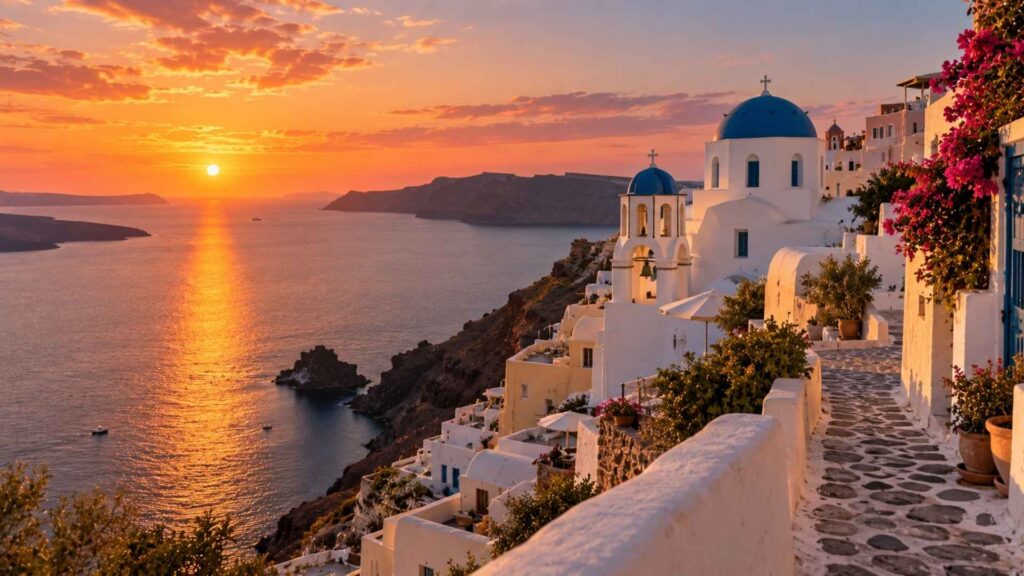
The Greece Golden Visa EUR 250,000 option is the most misunderstood residency route in Southern Europe. Marketing continues to refer to Greece as ‘the EUR 250,000 golden visa’ even though the general property threshold has risen to EUR 400,000 or EUR 800,000 depending on location since 31 August 2024, under Law 5100/2024. The EUR 250,000 threshold still exists, but only for two specific and narrow property categories: commercial-to-residential conversions and restoration of listed heritage buildings. For HNWI who understand what these routes actually require, they represent the lowest-capital real-estate-based EU golden visa currently available. For buyers who go in expecting a straightforward EUR 250,000 property purchase, the reality is materially more complex.
The EUR 250,000 route in 2026 reflects Greek policy priorities of two kinds. First, urban renewal: converting underused commercial properties (former offices, warehouses, retail spaces) in Athens and other cities into residential housing addresses supply constraints without creating new construction on undeveloped land. Second, cultural preservation: restoring Greece’s substantial inventory of listed historic buildings (pre-1900 structures classified by the Ministry of Culture as preserved monuments) maintains heritage assets that would otherwise deteriorate. Both routes serve Greek social objectives while providing a lower-cost entry point for investors who genuinely engage with these specific property types. Article 44 of Law No. 5162/2024 also introduced a parallel EUR 250,000 investment route into companies registered in the Elevate Greece National Startup Registry, providing a non-property alternative at the same threshold.
Here is the honest 2026 guide to the Greece Golden Visa EUR 250,000 route: what actually qualifies under commercial conversion versus historic restoration, the completion-before-application timing requirement, the specific inventory challenges of finding qualifying properties, the substantial Greek property tax and short-term rental prohibitions, the 5-year permit structure with 7-year citizenship pathway, and who this specific route actually fits versus the higher EUR 400,000 or EUR 800,000 tiers.
2026 GREECE GOLDEN VISA UPDATE: Greece Golden Visa under Law 5100/2024 (effective 31 August 2024) operates on three-tier property thresholds. EUR 800,000 in Attica (Greater Athens), Thessaloniki, Mykonos, Santorini, and islands with population above 3,100. EUR 400,000 in all other Greek regions. EUR 250,000 remains available only for two specific property categories nationwide: (a) commercial-to-residential property conversions and (b) restoration of listed heritage buildings. The 120 sqm minimum property size does NOT apply to the EUR 250,000 category. Conversion or restoration works must be completed BEFORE the Golden Visa application is filed. Article 44 of Law No. 5162/2024 introduced a parallel EUR 250,000 investment option in Elevate Greece National Startup Registry companies (effective early 2026). Short-term rentals (Airbnb-style) are PROHIBITED on Golden Visa properties, with EUR 50,000 fine and permit revocation as consequences. Long-term leasing is permitted. 5-year renewable residence permit, no mandatory stay requirement, family inclusion. Citizenship eligibility after 7 years of continuous legal residency plus B1 Greek language. Source: Greek Law 5100/2024, Law 5162/2024, and Circular 1/2026.
The Three-Tier Structure Explained
Understanding where EUR 250,000 sits within the broader Greece Golden Visa framework is essential to correct positioning.
Tier 1: EUR 800,000 (prime zones)
The highest threshold applies to the most in-demand and highest-liquidity Greek real estate markets:
- Attica (the Greater Athens metropolitan region, including central Athens, Kifisia, Glyfada, Vouliagmeni, and the Athens Riviera)
- Thessaloniki metropolitan area
- Mykonos island
- Santorini island
- All Greek islands with population above 3,100 residents (includes Corfu, Rhodes, Crete, Paros, Naxos, Zakynthos, and others)
Tier 1 investment must be a single property of minimum 120 square meters. Two or more properties combining to reach the threshold do not qualify; the investment must be in one qualifying property. This tier is popular with HNWI who want the specific value and prestige of premium Greek addresses.
Tier 2: EUR 400,000 (all other Greek regions)
The middle tier applies to Greek regions outside the prime zones: most of the Peloponnese (including Kalamata and Nafplio), most of Crete outside the specific prime zones, smaller islands with population below 3,100, inland mainland regions, and northern Greece outside the Thessaloniki metropolitan area. Same 120 sqm minimum and single-property requirement as Tier 1. Popular options include restored Venetian houses in Nafplio, coastal villas in Kalamata and Mani, stone villas on Paros or Naxos, and premium properties in Chania region of Crete.
Tier 3: EUR 250,000 (conversion and restoration nationwide)
The lowest tier applies exclusively to two specific property categories, and is available anywhere in Greece (not restricted to any zone):
- Commercial-to-residential property conversion: buying a former office, warehouse, retail unit, or aparthotel and completing the change of use to residential
- Restoration of listed heritage buildings: pre-1900 buildings classified by the Greek Ministry of Culture as ‘preserved monuments’ or of historical significance
Critically, the 120 sqm minimum size requirement does NOT apply to the EUR 250,000 category. Nor does the single-property restriction apply in exactly the same way. But the conversion works or restoration must be COMPLETED before the Golden Visa application is filed. This timing requirement is where most EUR 250,000 route attempts encounter difficulty.
The Commercial-to-Residential Conversion Route in Detail
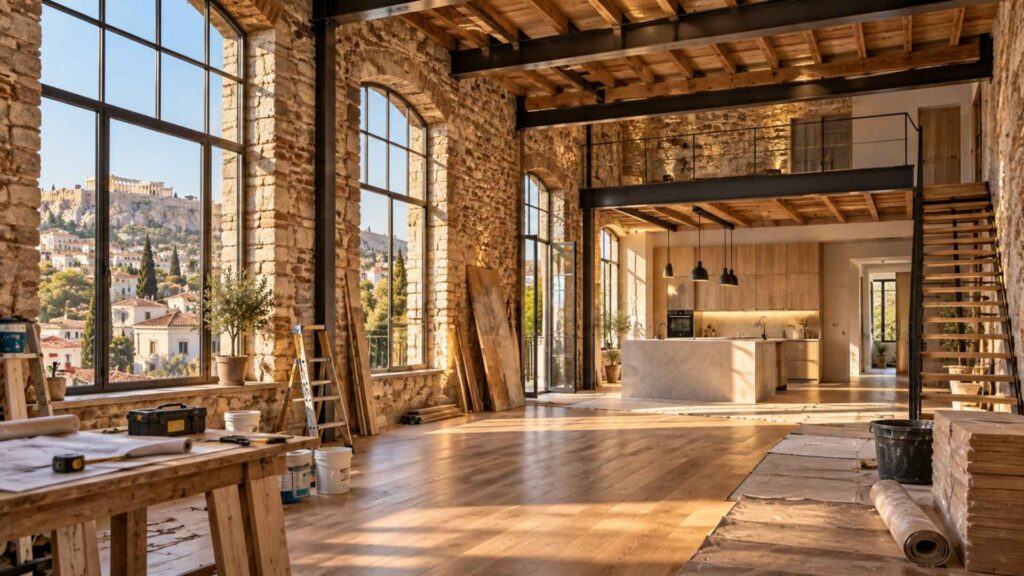
The conversion route requires purchase of a non-residential property and completion of change-of-use conversion to residential.
What qualifies as commercial conversion
Eligible starting properties include:
- Former offices and office buildings
- Former warehouses and industrial premises
- Former retail units (shops, stores, showrooms)
- Former workshops and production facilities
- Former aparthotels or short-stay commercial accommodations
- Former restaurants, bars, or hospitality-use spaces
Common in central Athens (Plaka, Monastiraki, Kolonaki former workshops), Piraeus (former commercial buildings converted to lofts), Thessaloniki central districts, and select areas of Patras, Larissa, and other major Greek cities. The property is purchased with existing commercial classification, then the buyer completes renovation and formal change of use to residential status through Greek planning authorities.
The total EUR 250,000 threshold
Important detail: the EUR 250,000 threshold applies to the TOTAL investment (property purchase plus renovation), not just the initial property price. Practical structure:
- Property purchase (commercial): typically EUR 100,000 to EUR 180,000 depending on location and size
- Renovation and change-of-use conversion: typically EUR 70,000 to EUR 150,000 depending on scope
- Combined investment must reach EUR 250,000 minimum, verified through official documentation of both the purchase and renovation costs
Buyers whose property purchase is well below the threshold (for example, a EUR 80,000 warehouse in a less central area) must ensure that renovation costs bring the total investment to EUR 250,000. Renovation costs must be genuine and documented; artificial inflation of costs to reach the threshold is subject to Greek tax authority scrutiny and can jeopardize the application.
The completion-before-application requirement
This is the single most critical structural requirement of the EUR 250,000 conversion route. The full conversion (both physical renovation and legal change of use through planning authorities) must be completed BEFORE the Golden Visa application is submitted. Practical implications:
- The investor bears the timing and execution risk of the renovation project
- Renovation typically takes 6-18 months depending on scope, permits, and contractor availability
- Legal change of use through Greek planning authorities can add several months
- During this pre-application period, the investor does not have Golden Visa status and must be in Greece under a different visa if physical presence is required for the project
- Renovation cost overruns and delays are the investor’s risk; there is no partial-completion Golden Visa fallback
- Only after the property is legally residential and the total documented investment is verified can the Golden Visa application be filed
The Heritage Restoration Route in Detail
The restoration route requires purchase of a listed heritage building and completion of preservation-compliant restoration.
What qualifies as listed heritage building
Eligible properties are pre-1900 buildings formally classified by the Greek Ministry of Culture as one of:
- Preserved monuments (diatiritea mnemeia)
- Buildings of historical or architectural significance registered under Greek cultural heritage law
- Structures within protected historic districts subject to preservation requirements
Common locations with substantial heritage inventory include:
- Nafplio old town (extensive Venetian and Ottoman-era buildings)
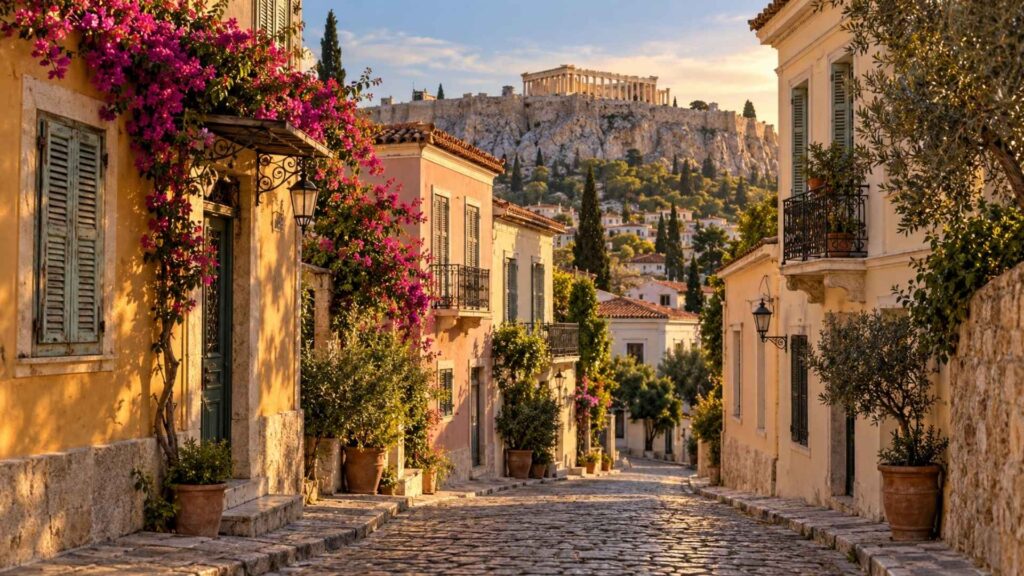
- Athens Plaka district (19th-century neoclassical structures)
- Hydra island (traditional stone captain’s mansions)
- Symi island (neoclassical harbor architecture)
- Corfu old town (Venetian palazzi and townhouses)
- Chania and Rethymno on Crete (Venetian old town)
- Various heritage villages across mainland Greece
Restoration requirements
Restoration must comply with strict preservation rules:
- Original facades and structural elements must be preserved
- Materials used must be historically appropriate (traditional stone, wood, plaster techniques)
- Modern amenities (electricity, plumbing, heating) can be added but discretely, without altering visible historic character
- All work requires approval from the Ministry of Culture and often specific committees for particularly significant buildings
- Some elements may require specialized craftsmen and specific materials, adding cost and time
The specialized nature of heritage restoration typically requires engagement with Greek architects and contractors experienced in preservation work. Restoration costs are often materially higher per square meter than standard renovation, and timelines are typically longer due to permit requirements and specialized work.
The financial math of restoration route
Typical financial structure of a heritage restoration route:
- Heritage property purchase: EUR 80,000 to EUR 200,000 depending on size, location, and condition (often heavily damaged or partially collapsed structures are cheaper)
- Restoration costs: EUR 80,000 to EUR 250,000+ depending on scope and specific requirements
- Total investment must reach EUR 250,000 minimum, documented through purchase deeds, contractor invoices, and material receipts
- Additional professional fees for specialist architects, heritage consultants, permit applications, and archaeological review
The Alternative: EUR 250,000 Startup Investment
Under Article 44 of Law No. 5162/2024, Greece introduced a parallel EUR 250,000 investment option not requiring property.
What qualifies as Elevate Greece investment
The startup investment route requires:
- Minimum EUR 250,000 investment in a Greek company registered in the Elevate Greece National Startup Registry
- The startup must maintain active registration in Elevate Greece throughout the investment holding period
- Investment structured as equity in the company (not loan)
- 5-year holding period requirement
Elevate Greece is the government-managed Greek national startup registry, established to accelerate innovation ecosystem development. Registered startups meet specific criteria for innovative activity, growth potential, and sector alignment (technology, biotech, clean energy, and comparable innovation sectors).
Startup route considerations
This route provides an alternative for buyers who prefer capital deployment into productive investment rather than real estate. Key considerations:
- Higher underlying investment risk than real estate (startups can fail; capital preservation is not assured)
- Specific fund manager or direct startup investment analysis required (not just Golden Visa consideration)
- Illiquidity during the 5-year hold period
- Provides exposure to Greek innovation ecosystem
- Same 5-year renewable Golden Visa permit as property routes
For HNWI whose priorities include Greek residency plus productive startup investment exposure, this route provides an alternative to the property routes. For buyers whose priority is capital preservation, real estate typically fits better despite the specific challenges of the EUR 250,000 conversion and restoration routes.

The Golden Visa Permit Itself
Regardless of investment route, the Greek Golden Visa permit itself has specific characteristics.
Permit structure
- 5-year renewable residence permit
- Renewable indefinitely as long as investment is maintained
- No minimum residence requirement (no minimum stay to maintain the permit)
- Full Schengen area visa-free access throughout permit validity
- Family inclusion (spouse, dependent children under 21, dependent parents of both spouses)
- Right to reside in Greece; work rights limited (Golden Visa is primarily for investors, not employees)
- Access to Greek healthcare and education systems for permit holders and family
Short-term rental prohibition
This is a critical operational restriction on Greek Golden Visa properties. Since Law 5100/2024:
- Short-term rentals (Airbnb, Booking, VRBO short-stay listings) are strictly PROHIBITED on Golden Visa properties
- Violation triggers EUR 50,000 fine plus Golden Visa permit revocation
- Long-term leasing (12+ month rental agreements) is permitted
- Owner-occupation is permitted
This substantially changes the economics of Golden Visa property investment. Buyers who purchased Greek Golden Visa properties in 2020-2023 with an expectation of short-term rental income can no longer generate that yield without risking their permit. New buyers must plan for either long-term leasing (typically lower gross yields but stable), owner-occupation, or property held without rental income.
Path to citizenship
Greek citizenship after Golden Visa residency requires:
- 7 years of continuous legal residency in Greece (substantial actual presence required, not just permit ownership)
- B1 Greek language proficiency
- Passing civic knowledge test on Greek history, culture, and institutions
- Genuine integration and connection to Greek life
- Application through general naturalization process
The 7-year timeline is competitive within Southern Europe (matches or beats Portugal’s post-reform 10-year requirement for most nationals, though Portugal’s CPLP/EU pathway remains at 7 years). Greek citizenship requires substantially more actual residency and language integration than Portuguese Golden Visa progression typically demands, so buyers pursuing Greek citizenship should plan for genuine Greek life rather than just permit maintenance.
Who the EUR 250,000 Route Actually Fits
It fits you if:
- Cost minimization is your primary priority and you have EUR 250,000 to deploy but not EUR 400,000 or more
- You have genuine interest in Greek heritage property or urban conversion, and are willing to manage a renovation project
- You have the time horizon and financial buffer to complete renovation before the Golden Visa application (6-18 months typical)
- You can manage or oversee the renovation from a distance or through Greek project managers
- You value the EU Schengen access and 7-year citizenship pathway
- You accept the short-term rental prohibition and plan for long-term leasing or owner-occupation
- You are considering the Elevate Greece startup investment route as an alternative to property renovation
It does not fit you well if:
- You want a straightforward EUR 250,000 property purchase without renovation complexity (the EUR 400,000 Tier 2 route in non-prime areas provides this)
- You want short-term rental yield (prohibited on Golden Visa properties)
- You need Golden Visa status immediately (renovation completion before application adds 6-18 months to total timeline)
- Your priority is capital deployment in prime real estate markets (Tier 1 or Tier 2 in premium areas)
- You want simpler EU-member-state PR without renovation project management (Cyprus PR at EUR 300,000 or Malta MPRP may fit better)
- You are not comfortable with Greek property renovation logistics, contractor management, and permit navigation
Frequently Asked Questions
Can I still get the Greece Golden Visa for EUR 250,000?
Yes, but only through specific routes: commercial-to-residential property conversion, restoration of listed heritage buildings, or EUR 250,000 investment in an Elevate Greece National Startup Registry company. The general EUR 250,000 residential property purchase route was eliminated by Law 5100/2024 effective 31 August 2024. Standard residential property purchase now requires EUR 400,000 in non-prime regions or EUR 800,000 in prime zones (Athens, Thessaloniki, Mykonos, Santorini, islands over 3,100 population).
Can I do the renovation after I get the Golden Visa?
No. The renovation or conversion must be completed and formally documented BEFORE the Golden Visa application is submitted. This is the critical structural difference between the EUR 250,000 conversion and restoration routes and the EUR 400,000 or EUR 800,000 direct-purchase routes. Investors pursuing the EUR 250,000 route must accept 6-18 months of pre-application project completion time, during which they hold no Golden Visa status.
Why is Airbnb banned on Golden Visa properties?
Greek policy prioritizes long-term housing supply over short-term tourist rental. The Airbnb prohibition on Golden Visa properties addresses concerns that Golden Visa investment was contributing to short-term rental inventory and housing unaffordability in Athens and Aegean islands. The EUR 50,000 fine plus permit revocation for violation is designed to be a genuine deterrent. Long-term leasing (12+ month rental agreements) is permitted; owner-occupation is permitted; but Airbnb-style short-term listing is not.
What is Elevate Greece and how does the startup investment route work?
Elevate Greece is the government-managed Greek national startup registry, established to support the Greek innovation ecosystem. A EUR 250,000 investment in a company registered in Elevate Greece qualifies for Golden Visa under Article 44 of Law No. 5162/2024. The investment must be equity (not loan), maintained for 5 years, and the startup must remain actively registered in Elevate Greece throughout the period. This route provides an alternative for buyers who prefer productive investment over property deployment, though with the higher underlying risk of any startup investment.
What is the total realistic cost including renovation and fees?
For a EUR 250,000 route via commercial conversion or heritage restoration: EUR 250,000 investment minimum (verified across purchase price and renovation costs combined) plus VAT and transfer taxes on the property purchase (approximately 3-25 percent of purchase price depending on VAT status and specific structure), plus Greek legal fees (typically EUR 5,000-15,000), plus renovation permit fees, plus Golden Visa application fees (approximately EUR 2,000 per adult applicant), plus professional agent fees. Realistic all-in cost EUR 290,000 to EUR 330,000 for the EUR 250,000 route, similar to Cyprus PR Category 6.2 all-in cost.
How long does the full process actually take?
For the EUR 250,000 conversion or restoration routes: 8-24 months total. This includes 6-18 months for renovation completion (varies substantially by project complexity), then 2-6 months for Golden Visa application processing after renovation is complete. For direct-purchase EUR 400,000 or EUR 800,000 routes, total timeline is 2-6 months from property purchase to Golden Visa issuance. The EUR 250,000 route requires materially more time investment than the higher-tier direct-purchase routes.
Can I use a bank loan or mortgage for the investment?
No. Greek Golden Visa investments must be financed with the applicant’s own funds. Bank loans, mortgages, or third-party financing arrangements do not qualify. Documentation of the source of the applicant’s own funds is required as part of the application, including source of wealth verification. This is stricter than many other EU Golden Visa programs that permit some financing arrangements.
The Honest Conclusion
The Greece Golden Visa EUR 250,000 route in 2026 is a genuine and legitimate pathway to Greek and Schengen residence at the lowest capital threshold among EU real-estate-based Golden Visas. But it is not the straightforward EUR 250,000 property purchase that many buyers assume. The route requires either commercial-to-residential conversion (a renovation project the buyer must complete before applying) or heritage restoration (a specialized preservation project requiring architects and specific approvals) or Elevate Greece startup investment (with underlying startup risk). Each of these carries substantial complexity beyond simply committing EUR 250,000.
For HNWI who genuinely want to engage with Greek heritage property, urban renewal, or startup ecosystem investment, and who have the time and project management capacity for the renovation completion requirements, the EUR 250,000 route delivers real value at meaningfully lower cost than the EUR 400,000 or EUR 800,000 direct-purchase alternatives. For buyers who want simpler Greek Golden Visa deployment without renovation complexity, the EUR 400,000 route in non-prime regions provides that at 60 percent higher capital cost. Understanding what the EUR 250,000 route actually requires (not just the headline threshold) is essential to correct choice.
Your next step
Soland’s Pre-Qualification engagement evaluates whether the Greece Golden Visa EUR 250,000 route fits your specific priorities across cost, complexity tolerance, timeline, and property or startup investment goals. We compare this route honestly against the EUR 400,000 Tier 2 direct-purchase route (simpler at higher cost) and non-Greek alternatives (Cyprus PR at EUR 300,000, Portugal Golden Visa fund route at EUR 500,000, Italy Investor Visa at EUR 250,000 startup or EUR 500,000 equity). We coordinate with qualified Greek immigration counsel and, where relevant, with heritage restoration specialists or Elevate Greece investment advisors for specific route execution.
If Greece EUR 250,000 fits your situation, we structure the application through Greek counsel for the correct investment route and completion sequence. If a different route or jurisdiction serves you better, we tell you that first. Soland does not sell residency programs. We help families build the right cross-border structure for the next twenty years. Get in touch through solandworld.com or contact our advisory team directly.
📷 IMAGE HERE — An aspirational closing image conveying settled Greek lifestyle and long-term Mediterranean base: a peaceful Greek island sunset (Santorini, Hydra, or a quiet Cycladic island), a traditional Greek village at golden hour, or a Greek coastal vantage at dusk. Conveys settled Greek Mediterranean life.Suggested search: “greek island sunset santorini hydra OR traditional greek village golden hour OR greek coastal vantage dusk” (Unsplash / Pexels / Shutterstock)
Alt text: Peaceful Greek island sunset representing the settled long-term Mediterranean base available through the Greece Golden Visa EUR 250,000 route

