
While Portugal raised its Golden Visa to a €500,000 fund deployment and Greece’s premium zones now require €800,000, one EU country still grants residency by investment for as little as €50,000. Latvia, the smallest of the Baltic states, runs the cheapest active Golden Visa program in the European Union, and it has done so since 2010 with surprisingly little international attention.
The catch is not what most buyers expect. The €50,000 route is real, but it goes into a Latvian company as business investment, not into property or a passive fund. The real estate route starts at €250,000, government bonds at €250,000, and a five-year bank deposit at €280,000. Each route grants the same five-year residence permit with full Schengen access and no minimum stay requirement, but parliament is now considering changes that would reduce the company-investment permit duration from five years to two.
Here is how the Latvia Golden Visa works in 2026: the four investment routes, the real numbers, the proposed reforms, the path to citizenship, and who actually benefits from Europe’s lowest residency-by-investment threshold.

What the Latvia Golden Visa Actually Is
Latvia’s program, officially the Investor Visa or Residence Permit by Investment, is one of the oldest active Golden Visas in Europe. It was introduced in July 2010 as part of Latvia’s response to the 2008 financial crisis, designed to attract foreign capital into the country.
A five-year residence permit with EU mobility
The Latvia Golden Visa is a temporary residence permit, currently valid for up to five years, granted in exchange for a qualifying investment. It gives the holder and qualifying family members the right to live in Latvia, full Schengen Area travel rights (90 days in any 180-day period across 29 countries), and access to Latvia’s EU-level infrastructure, banking, healthcare, and education.
The program is governed by Section 23, Paragraph 1, Clause 28 of the Latvian Immigration Law. Processing typically takes two to four months from a complete application, among the fastest in Europe. There is no minimum stay requirement to maintain the permit, although holders must visit Latvia once a year to renew their residence permit ID card.
Why it stays under the radar
Latvia does not market its Golden Visa as aggressively as Portugal, Greece, or Spain did during their peak years. The Latvian property market is smaller, the developer-driven marketing machine is less active, and the country attracts a quieter, more strategic buyer profile rather than mass-market real estate purchasers. For some buyers, this is precisely the appeal: a less crowded program with lower thresholds, in a stable EU member state with a smaller exposure to the EU regulatory pressure that has reshaped the higher-profile programs.
The Four Investment Routes in 2026
Latvia offers four distinct qualifying investment routes, each suited to different buyer profiles.
Route 1: Company investment from €50,000
Investment in a Latvian company, starting from a minimum of €50,000, makes Latvia the cheapest active Golden Visa in the European Union. The capital must go into a real Latvian business entity, not a passive holding structure, and the company must meet specific criteria including a minimum turnover or tax payment threshold.
This is the route under proposed reform. Parliament is considering reducing the residence permit duration for this route from five years to two years, with effect possibly by mid- or late 2026. Anyone who receives the permit under current rules retains the full five-year validity. For buyers attracted to the €50,000 entry specifically, this argues for acting on current rules rather than waiting.
Route 2: Real estate from €250,000
The real estate route requires a minimum investment of €250,000 in Latvian property, anywhere in the country, without zoning restrictions of the kind Greece introduced in 2024. Latvia’s residential rental market generates competitive yields, with estimates around 7.9% to 8.5% in well-chosen segments, and properties can be rented short-term or long-term.
Compared to Greece’s three-zone system (€250K only through the heritage route, €400K standard, €800K premium areas) or Portugal’s elimination of real estate as a Golden Visa route in 2023, Latvia’s €250,000 flat threshold for any property anywhere is one of the more straightforward real estate Golden Visa structures still active in the EU.
Route 3: Government bonds from €250,000
A €250,000 investment in Latvian government bonds qualifies for the residence permit. This is a low-risk, government-backed route suited to buyers who prefer not to take real estate market exposure but want the same residency outcome at the same threshold. The bonds must be held for the duration of the qualifying period (five years).
Route 4: Bank deposit from €280,000
A five-year fixed-term bank deposit of €280,000 in a Latvian bank qualifies for the residence permit. The deposit must be maintained for the full five-year period. This route appeals to buyers who want their capital preserved in liquid form rather than in property or bonds, and is comparable in concept to the bank deposit routes in Panama (USD 750,000) or the UAE (AED 2 million).
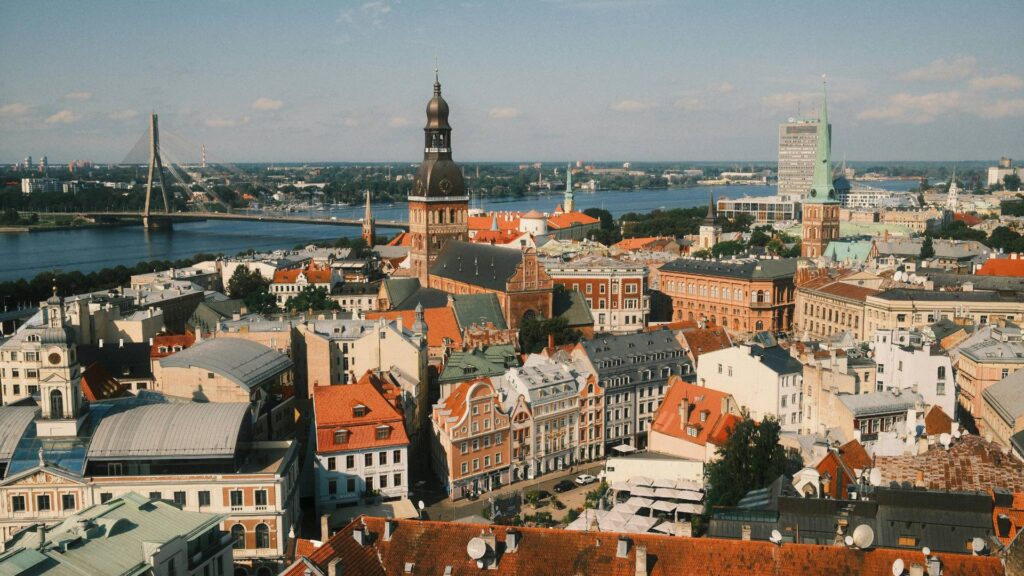
What the Latvia Golden Visa Delivers
The benefits are competitive with much more expensive EU programs, which is precisely the program’s positioning.
- A five-year renewable temporary residence permit
- Full visa-free travel across the Schengen Area’s 29 member states (90 days in any 180-day period)
- No minimum stay requirement to maintain the permit
- Family inclusion: spouse, dependent children, and dependent parents on a single application
- Access to Latvia’s EU-level banking, healthcare, and education systems
- Potential rental yields on real estate route (7.9% to 8.5% in well-chosen segments)
- Path to permanent residency after five years of continuous residence
- Path to Latvian citizenship after ten years of continuous residency (subject to language and integration requirements)
- Latvia permits dual citizenship under defined conditions
Schengen access at the lowest EU price
For a buyer whose primary use case is Schengen mobility rather than eventual EU citizenship, Latvia delivers the same Schengen access at the lowest capital threshold in the European Union. A €50,000 business investment, a €250,000 property, a €250,000 bond holding, or a €280,000 deposit all produce the same Schengen residence card. Compared to Portugal’s €500,000 fund route or Greece’s €400,000 to €800,000 property routes, Latvia is meaningfully cheaper for the same EU residency outcome on a per-euro-deployed basis.
The Path to Latvian Citizenship
Latvia takes longer to reach citizenship than Portugal or France, and the language requirement is non-trivial.
Ten years to citizenship eligibility
Latvian citizenship through naturalization requires ten years of continuous residency, plus demonstration of Latvian language proficiency and knowledge of Latvian history and the constitution. This is twice as long as Portugal’s five-year route and three years longer than Greece’s seven years. The Latvian language requirement is genuine: Latvian is a small language with no significant overlap with English, German, or Romance languages, which makes it a meaningful commitment.
For buyers whose primary endpoint is EU citizenship, Latvia is therefore a slower path than several alternatives. For buyers whose primary endpoint is EU residency, with citizenship as a possibility rather than a target, Latvia’s lower entry threshold can be the deciding factor.
Permanent residency at five years
Permanent residency, distinct from citizenship, becomes available after five years of continuous residence. Permanent residency removes the renewal requirement and provides a more stable long-term EU base, even for buyers who do not pursue full citizenship. For many Latvia Golden Visa holders, permanent residency at year five is the realistic endpoint, with citizenship as an optional next step that some pursue and many do not.

Who the Latvia Golden Visa Fits
The program suits a specific buyer profile, and the wrong buyer wastes capital on a residency that does not deliver what they actually need.
It fits you if:
- You want EU residency and Schengen access at the lowest possible capital threshold
- Your primary use case is mobility and a European foothold rather than the fastest path to a passport
- You can deploy €50,000 in a Latvian business (with awareness of the proposed 2-year permit reform) or €250,000 to €280,000 in property, bonds, or a deposit
- You value the absence of a minimum stay requirement and the flexibility to maintain the permit without relocating
- You are comfortable with a 10-year path to citizenship and the genuine Latvian language requirement, or you are comfortable stopping at permanent residency
- You see Latvia as an EU base for diversification, not necessarily as a country you will relocate to full-time
A different program fits you better if:
- Your primary goal is the fastest path to an EU passport, in which case Portugal or France (5 years) is structurally faster
- You want a Mediterranean lifestyle, in which case Greece, Portugal, or Italy may fit better despite the higher cost
- You need a second passport in months rather than residency over years, in which case Caribbean CBI is the faster instrument
- You want zero physical visits and pure documentary residency, which Latvia does not provide (annual renewal visit is required)

The 2026 Regulatory Context
Latvia operates in the same broader EU regulatory environment that has reshaped Golden Visas elsewhere, but it has so far avoided the most aggressive restructuring.
The proposed company investment reform
As noted above, parliament is considering amendments that would reduce the residence permit duration for the €50,000 company investment route from five years to two years. The timing of these reforms is not yet final but could take effect by mid- or late 2026. Anyone who receives a permit under current rules retains five-year validity.
Practical implication: for buyers specifically considering the €50,000 route, acting under current rules is materially advantageous. Permits issued before the reform retain their original duration. Permits issued after would require renewal every two years instead of every five, with the associated administrative costs and friction. The other routes (real estate, bonds, deposit) are not directly affected by the proposed company-investment-specific changes.
The EU regulatory environment
The broader EU pressure on Golden Visa programs has produced the Cyprus closure in 2020, the Malta Court of Justice ruling in April 2025, Spain’s Golden Visa real estate closure in April 2025, and Portugal’s removal of real estate in October 2023. Greece restructured into its three-zone system in August 2024. Latvia has not been targeted by any equivalent EU action to date.
This does not make the program immune to future change. Latvia’s relatively small program size and its position as the lowest-cost EU Golden Visa make it visible to EU policy discussions, but it has not faced the same political pressure as the higher-profile programs. The sensible posture, as always with investment migration, is to act when current thresholds are attractive rather than to assume they will remain in place indefinitely.
Frequently Asked Questions
Is the €50,000 Latvia Golden Visa really the cheapest in the EU?
Yes, currently. €50,000 in a qualifying Latvian company investment is the lowest active threshold for EU residency by investment in 2026. The route is real but specific: the capital must go into a real Latvian business meeting defined criteria, not into a passive holding structure. The €250,000 real estate route is also among the cheapest EU property routes for any qualifying property anywhere in the country, comparable to Greece’s Zone C heritage route but with fewer property-type restrictions.
Will my €50,000 company investment permit really be reduced to two years?
Possibly. Parliament is considering amendments that would reduce the permit validity for the company investment route from five years to two years, potentially taking effect mid- or late 2026. The timing is not yet final. Anyone who receives the permit under current rules retains the full five-year validity. This is precisely why timing matters for this specific route: acting before any reform takes effect locks in five-year validity, while waiting risks getting a two-year permit if the reform passes.
Do I have to live in Latvia to keep the residency?
No minimum stay requirement to maintain the residence permit. However, you must visit Latvia once a year to renew your residence permit ID card. Tax residency is a separate matter: holding the permit does not by itself create tax residency, and Latvia taxes foreign retirement income such as US Social Security or private pensions if you become a Latvian tax resident. As always, cross-border tax advice should precede any structural decision.
How long until I can get a Latvian passport?
Ten years of continuous residency, plus Latvian language proficiency and knowledge of Latvian history and the constitution. This is longer than Portugal (five years) or Greece (seven years of tax residency). The Latvian language requirement is genuine. For buyers whose primary goal is the fastest EU passport, Latvia is not the route. For buyers whose primary goal is EU residency at the lowest capital cost, with citizenship as a possibility rather than a target, Latvia is highly competitive.
Can I include my family?
Yes. The Latvia Golden Visa allows the inclusion of the spouse, dependent children, and dependent parents on a single application. Family member fees are modest by EU Golden Visa standards. The same Schengen and Latvian residency benefits extend to all included family members.
Is the Latvian real estate market a good investment beyond the visa?
Latvian residential property has generated competitive rental yields in well-chosen segments, with estimates around 7.9% to 8.5% in central Riga and other established areas. The market is smaller and less liquid than Western European markets, which means independent valuation and a clear-eyed view of the property as an investment, separate from its visa function, is essential. For buyers who view the property as primarily a Golden Visa qualifier with rental income as a secondary benefit, the Latvian real estate route is reasonable. For buyers expecting the property itself to be a primary investment thesis, the smaller market warrants more careful diligence.
How does Latvia compare to other EU Golden Visas?
Latvia is the cheapest active EU Golden Visa (€50,000 minimum, vs €500,000 for Portugal’s fund route and €250,000 to €800,000 for Greece by zone). It is structurally more straightforward (no zone system like Greece, no fund subscription complexity like Portugal). It is slower to citizenship (10 years vs 5 for Portugal, 7 for Greece). It has lower EU regulatory pressure currently. For pure mobility and a European foothold at the lowest cost, Latvia wins; for the fastest passport, Portugal or France is the choice.
The Honest Conclusion
Latvia runs the cheapest active Golden Visa in the European Union, and it has done so for fifteen years with surprisingly little international attention. For a buyer whose primary goal is EU residency and Schengen mobility at the lowest capital cost, Latvia is structurally competitive in a way no other current EU program matches.
The honest caveats are two. First, the 10-year path to citizenship and the genuine Latvian language requirement mean Latvia is the wrong choice for buyers whose primary goal is a fast EU passport. Second, the proposed reform to the €50,000 company investment route argues for acting on current rules rather than waiting, particularly for that specific route. For the right buyer (EU mobility, lower threshold, comfortable with a longer path to citizenship or content with permanent residency at five years), Latvia is one of Europe’s quiet best-kept options.

Your Next Step
Soland’s Pre-Qualification engagement evaluates which Latvia Golden Visa route fits your specific situation, how the proposed company investment reform affects your timeline, and how Latvia compares to alternative EU and non-EU residency options for your goals.
If Latvia is the right fit, we structure the application around the correct route and target completion under current rules where it matters. If a different program serves your goals better, we tell you that first. Soland does not sell properties or funds. We help families build the right cross-border structure for the next twenty years. Get in touch through solandworld.com or contact our advisory team directly.

