
Since the July 2024 Memorandum of Agreement among the five Eastern Caribbean CBI nations set a regional floor of USD 200,000, and since ECCIRA (the Eastern Caribbean Citizenship by Investment Regulatory Authority) became operational in Q2 2026, the pricing landscape of the Caribbean has flattened. Grenada sits at USD 235,000, St. Lucia at USD 240,000, St. Kitts at USD 250,000, and Antigua at USD 230,000 for a family of four. Dominica sits alone at USD 200,000, the lowest legitimate Caribbean CBI entry point available, and the lowest since the regional harmonization.
Dominica’s program, established in 1993, is one of the oldest CBI programs in the world (second only to St. Kitts, which launched in 1984). Over thirty years of continuous operation, adjustment, and refinement have produced a program that is efficient, well-documented, and (unlike some newer entrants) has both institutional maturity and clear regulatory frameworks. The 2026 ECCIRA reforms have added mandatory 30-day physical residency across the first five years for files lodged from July 2026 onward, harmonized due diligence standards, mandatory interview at age 16+, and biometric capture.
Here is how Dominica citizenship by investment works in 2026: the two investment routes, the process, the family inclusion rules, the passport value, the ECCIRA changes, and who Dominica actually fits.
2026 REGULATORY UPDATE: ECCIRA (Eastern Caribbean Citizenship by Investment Regulatory Authority) became operational in Q2 2026, headquartered in Grenada. It harmonizes standards across the 5 OECS Caribbean CBI programs (Dominica, Antigua and Barbuda, Grenada, St. Lucia, and St. Kitts and Nevis). Under ECCIRA, all 5 programs share a USD 200,000 minimum investment floor, harmonized background-check protocols, mandatory interview for applicants aged 16 and older, and a 30-day physical residency requirement across the first 5 years for files lodged from July 2026 onward. Dominica’s interview is conducted virtually under the ECCIRA framework, with biometric capture at the interview stage.

What Dominica Citizenship Actually Is
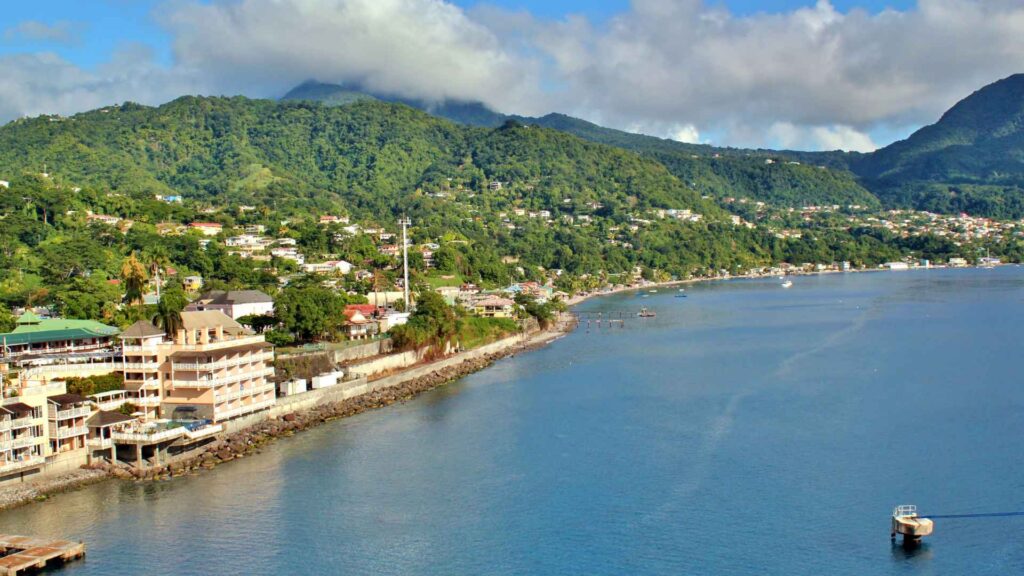
Dominica (not to be confused with the Dominican Republic) is a small Eastern Caribbean island nation of approximately 72,000 residents. Known as the ‘Nature Isle’ for its dense rainforests, volcanic mountains, and largely undeveloped coastline, Dominica has operated its CBI program since 1993, making it one of the oldest continuously running such programs in the world.
Full citizenship, not residency
Dominica CBI grants full citizenship for life through either a non-refundable donation to the Economic Diversification Fund (EDF) or a qualifying real estate investment. Citizenship is inheritable by descendants and permits dual nationality (so applicants generally do not need to renounce their original citizenship). The citizenship is issued under the Commonwealth of Dominica Constitution and is recognized internationally.
Prior to July 2026, there was no physical presence requirement. Under the ECCIRA framework taking effect from July 2026, applicants must complete 30 days of physical residency in Dominica across the first five years of citizenship. This is a materially lighter requirement than the residency demands of most Golden Visa programs (which typically require 7 to 183+ days per year), but it is a change from the pre-ECCIRA zero-residency structure.
Why Dominica is different from newer programs
Thirty-three years of operating history (1993 to 2026) means Dominica has established relationships with international banks, immigration authorities, and government agencies globally. Newer programs like Sao Tome (launched 2025) or Nauru have limited operational track record and correspondingly limited institutional recognition. For buyers who prioritize the credibility of a program with decades of continuous operation, Dominica delivers that in a way newer low-cost alternatives cannot match.
The Two Investment Routes
Dominica offers two qualifying investment routes with materially different structures.
Route 1: Economic Diversification Fund (EDF), USD 200,000 non-refundable
The EDF donation is the most straightforward route. A single applicant contributes USD 200,000 to the Economic Diversification Fund, a government vehicle that finances national development projects in sectors including agriculture, education, healthcare, tourism, and infrastructure. The donation is non-refundable; there is no eventual capital recovery.
For a family of four (main applicant, spouse, and two dependents), the EDF donation is USD 250,000. Each additional dependent adds approximately USD 25,000 to USD 50,000 depending on the dependent’s age and relationship. Government processing fees, due diligence fees (USD 7,500 per main applicant plus USD 4,000 per adult dependent), passport fees, and agent and legal fees are additional.
Route 2: Real Estate Investment, USD 200,000 minimum
The real estate route requires a minimum investment of USD 200,000 in a government-approved real estate project (typically hotel or resort developments). The investor receives shares or ownership in the approved property and must hold the investment for a minimum three-year period before resale (or five years for resale to another CBI applicant under the same program).
This route preserves capital: the investor holds a tangible asset with potential rental income through the holding period and the prospect of resale. It also carries the risks of any real estate investment (property market fluctuations, project completion delays, and the specific commercial risks of the chosen project). Processing time is generally longer than the EDF route because of the additional real estate due diligence required.
A USD 75,000 government fee applies to real estate route applications, in addition to the property investment itself. Due diligence fees and other charges also apply. The all-in cost of the real estate route is typically higher than the EDF donation, though the potential capital recovery makes it structurally attractive for buyers who can commit to the holding period and manage the property risks.

The Process: 6 to 9 Months Under ECCIRA
Dominica processing has become slightly more involved under the ECCIRA framework in 2026 but remains among the faster Caribbean options.
The application sequence
First, preliminary eligibility and document preparation. Working with a licensed authorized agent (direct applications to the government are not permitted), the applicant assembles passport copies, criminal record certificates (apostilled and legalized), proof of source of funds, medical certificates, photographs, and completed application forms. Typical preparation time: 4 to 8 weeks.
Second, formal application submission and due diligence. The complete application is submitted to the Dominica Citizenship by Investment Unit (CBIU). Government due diligence fees (USD 7,500 main applicant plus USD 4,000 per adult) are paid at this stage. International due diligence agencies conduct background checks.
Third, mandatory interview (16+). All applicants aged 16 and older must complete a mandatory interview under both the July 2023 Dominica rule and the ECCIRA harmonization. Dominica’s interview is conducted virtually under the ECCIRA framework, with biometric capture completed at the interview stage. This is more applicant-friendly than in-person requirements at other Caribbean programs.
Fourth, approval in principle and investment completion. Upon approval, the applicant makes the qualifying investment (EDF donation or real estate transaction). Only after this stage is the actual investment made; before that, no principal capital is committed.
Fifth, oath of allegiance and passport issuance. The applicant takes the oath of allegiance (which can be completed at Dominican diplomatic missions abroad or through defined proxy procedures). Passports are typically issued and delivered within 2 to 4 weeks after oath completion.
Total realistic timeline: 6 to 9 months from complete application to passport in hand, with 9 months being a common average.
The July 2026 residency introduction
For files lodged from July 2026 onward, the ECCIRA framework introduces a 30-day physical residency requirement across the first five years of citizenship. This can be completed in a single trip or split across multiple visits. Dominica has no daily quota within the five-year window; the applicant simply must accumulate 30 days of presence before the five-year anniversary.
For files lodged before July 2026 (currently a narrowing window as we move through 2026), this requirement does not apply retroactively. Applicants considering Dominica in 2026 may want to act promptly to lock in the pre-ECCIRA residency-free framework, though the 30-day requirement is genuinely modest by comparative standards.
What the Dominica Passport Delivers
Dominica citizenship is not just the cheapest Caribbean CBI; the passport itself delivers meaningful mobility, though with the same regulatory considerations that affect all Caribbean passports in the 2026-2027 window.
Visa-free and visa-on-arrival access
The Dominica passport provides visa-free or visa-on-arrival access to approximately 140 to 160 destinations, depending on the source and how visa-on-arrival is counted, including:
- EU Schengen Area (currently visa-free for 90 days in any 180-day period; subject to EU regulatory review through 2026-2027)
- United Kingdom (currently visa-free for short stays; subject to review)
- Singapore, Hong Kong, and much of Asia
- Russia, China (10-year multiple-entry facility), and CIS states
- Most of the Caribbean, Latin America, and Africa
- Not visa-free: United States, Canada, Australia, New Zealand, Japan
The EU Schengen risk
The most important consideration for any Caribbean CBI passport in 2026 is the EU Schengen regulatory context. The EU has been considering the suspension of visa-free access for CBI passports across the region. Vanuatu already lost full Schengen access in December 2024. Similar action on the Caribbean five (Dominica, Antigua, Grenada, St. Lucia, and St. Kitts) has been publicly discussed and remains under consideration in 2026-2027.
For buyers whose primary use case for Caribbean CBI is European travel, the Schengen risk is a genuine consideration. Locking in current access now provides current benefits; ongoing access beyond any future EU decision is not guaranteed. For buyers whose primary use case is broader (tax planning, Plan B optionality, banking access, non-European mobility), the Schengen risk is less central to the value proposition.
Tax benefits
Dominica does not tax the worldwide income, capital gains, dividends, or inheritance of its citizens who do not become Dominica tax residents. For citizens establishing genuine Dominica tax residency, the tax framework remains highly favorable. Most Dominica CBI holders do not establish Dominica tax residency; the citizenship provides tax neutrality (no additional Dominican tax obligation for non-residents) rather than active tax benefits. Cross-border tax positioning continues to depend on the individual’s actual tax residency location, not on the possession of Dominica citizenship alone.
Family Inclusion Under Dominica
Dominica’s family inclusion structure is comparable to other Caribbean programs, though the specific rules and cost structures vary.
Who can be included
- Spouse or registered partner
- Dependent children under 18
- Dependent children ages 18-30 who are full-time students at accredited institutions and financially dependent on the main applicant
- Dependent parents and grandparents over age 55 (if financially dependent)
- Dependent siblings (in some circumstances)
- Newborns can be added after main applicant’s citizenship is granted, at reduced fees
Family pricing under EDF route
- Single applicant: USD 200,000 donation
- Main applicant + spouse (family of 2): USD 200,000
- Family of 4 (main + spouse + 2 children under 18): USD 250,000
- Each additional dependent: USD 25,000 to USD 50,000 depending on age and relationship
- Plus due diligence fees, government fees, passport fees, agent and legal fees on top of the donation amounts
How Dominica compares on family cost
For a single applicant, Dominica at USD 200,000 is the cheapest Caribbean option. For a family of four, Dominica’s USD 250,000 EDF donation is slightly more than Antigua’s NDF at USD 230,000, but broadly competitive with Grenada’s USD 235,000 flat, St. Lucia’s USD 240,000, and St. Kitts’ USD 250,000 SISC. For very large families (six or more), Antigua’s UWI Fund at USD 260,000 (which includes tuition benefits at the University of the West Indies) is structurally the most economical Caribbean choice.
Who Dominica Fits
Dominica occupies a specific niche in the Caribbean CBI market: cost-conscious buyers who value institutional maturity and want the lowest legitimate Caribbean entry point.
It fits you if:
- You want the lowest cost Caribbean CBI at USD 200,000 for a single applicant (or USD 250,000 for a family of four via EDF)
- You value institutional maturity: 33 years of continuous program operation, decades of documented processing, established banking and immigration relationships
- You are comfortable with the July 2026 ECCIRA 30-day residency introduction (or you can lodge your application before July 2026 to lock in the pre-ECCIRA structure)
- Your use case includes broad visa-free travel to Schengen, UK, Asia, and Russia (with the understanding that the Schengen access is subject to EU regulatory review)
- You have a smaller family (1 to 4 members) where Dominica’s pricing is genuinely most competitive
It does not fit you well if:
- You have a very large family (6+ members), in which case Antigua’s UWI Fund at USD 260,000 with tuition benefits is more economical
- You specifically need US business access via the E-2 Investor Treaty, in which case only Grenada among the Caribbean CBI programs delivers it
- You want the strongest possible Caribbean passport with the longest institutional track record, in which case St. Kitts (since 1984) has the edge
- You need the fastest possible processing, in which case St. Kitts’ 60-day accelerated route is materially faster than Dominica’s 6-9 months
- You are entirely focused on lowest cost and don’t need institutional maturity, in which case Sao Tome and Principe at USD 90,000 is materially cheaper (though newer and with limited passport mobility)
Frequently Asked Questions
Is Dominica really the cheapest Caribbean CBI?
Yes, at the USD 200,000 EDF donation level for a single applicant. This is the harmonized regional floor established in July 2024 and ratified under ECCIRA. For families of four, Dominica’s USD 250,000 is broadly competitive but slightly higher than Antigua’s USD 230,000. For families of six or more, Antigua’s UWI Fund at USD 260,000 with tuition benefits is more economical. Dominica’s cost advantage is strongest for single applicants and small families up to 4 members.
How long does the Dominica process actually take?
6 to 9 months from complete application to passport in hand, with 9 months being a common average. This includes 4-8 weeks of document preparation, formal application and due diligence, the mandatory interview, approval in principle, investment completion, oath of allegiance, and passport issuance. The virtual interview under ECCIRA has streamlined the process compared to programs requiring in-person appointments.
Do I have to travel to Dominica?
For files lodged from July 2026, yes: 30 days of physical residency in Dominica across the first five years of citizenship. This can be completed in a single trip or split across multiple visits. For files lodged before July 2026, no travel is required. The interview under ECCIRA is virtual for Dominica, so applicants don’t need to travel for the interview itself. Only the eventual 30-day residency (for post-July 2026 files) requires physical presence.
What is the total all-in cost for a family of four?
Approximately USD 300,000 to USD 320,000 for a family of four via the EDF route, including: USD 250,000 EDF donation, USD 7,500 main applicant due diligence + USD 4,000 per adult dependent, USD 3,000 government fees per applicant, passport fees, and agent and legal fees (typically USD 25,000 to USD 50,000 depending on the agent selected). The real estate route adds property costs and USD 75,000 government fees but recovers most of the capital through the underlying real estate.
Can I still travel visa-free to the Schengen Area?
As of mid-2026, yes. Dominica passport holders currently have visa-free access to the Schengen Area for 90 days in any 180-day period. However, the EU is actively considering suspension of visa-free access for Caribbean CBI passports through 2026-2027, following the precedent set by Vanuatu’s suspension in December 2024. For buyers whose primary use case is European travel, this is a genuine consideration; current access is not guaranteed to continue indefinitely.
What are the 2026 ECCIRA changes?
The Eastern Caribbean Citizenship by Investment Regulatory Authority became operational in Q2 2026 and harmonizes standards across the five Caribbean CBI programs. Key changes: USD 200,000 minimum investment floor across all five (already largely in place since the July 2024 MoA), harmonized due diligence protocols, mandatory interview for applicants aged 16 and older, biometric capture requirements, and 30-day physical residency across the first five years for files lodged from July 2026 onward. These changes tighten and standardize the programs rather than restrict access.
Is Dominica citizenship inheritable?
Yes. Children born to Dominica citizens (whether born in Dominica or abroad) generally acquire Dominica citizenship by descent. This makes Dominica CBI a genuine intergenerational asset: the citizenship acquired by the main applicant passes to children and (in defined circumstances) grandchildren. This is a structural advantage over some Golden Visa programs where residency does not automatically extend to future descendants.
The Honest Conclusion
Dominica citizenship by investment in 2026 is the cost leader of the Caribbean CBI market at USD 200,000 for a single applicant, backed by 33 years of continuous program operation, institutional maturity, and comparable passport mobility to the more expensive Caribbean alternatives. For cost-conscious buyers with smaller families (1 to 4 members) who value program track record, Dominica is the structurally logical choice.
The honest caveats are the same for Dominica as for the rest of the Caribbean five in 2026: the EU Schengen regulatory review continues through 2026-2027 with uncertain outcome, the ECCIRA July 2026 residency introduction adds a modest but real physical presence requirement, and for very specific use cases (US E-2 access, largest families, fastest possible processing), a different Caribbean program fits better. For general Caribbean CBI purposes at the lowest legitimate price point, Dominica is what the market delivers.
Your next step
Soland’s Pre-Qualification engagement evaluates whether Dominica’s specific cost profile and program characteristics align with your goals, and compares it directly against the other four Caribbean CBI programs (Antigua for larger families, Grenada for US E-2 access, St. Lucia for competitive pricing across multiple routes, St. Kitts for the premium passport). We never recommend Dominica when a different program better serves your situation, and we tell you clearly if the Schengen risk should shift your consideration.
If Dominica is the right fit, we coordinate the application through licensed authorized agents under current rules. If a different program serves you better, we tell you that first. Soland does not sell passports. We help families build the right cross-border structure for the next twenty years. Get in touch through solandworld.com or contact our advisory team directly.

