
You have a Russian, Lebanese, Nigerian, or Indian passport, and you have run the math. Your passport is the bottleneck. Banking is harder than it should be. Travel needs visas you do not have time to apply for. Your kids need optionality. You have been told the answer is a second passport, and you have started searching. Within twenty minutes, you have seen ads for St. Kitts at $250,000, Portugal at €500,000, and Greece at €250,000, and they all promise the same thing: freedom, mobility, and a Plan B.
They are not the same product.
A Caribbean citizenship and an EU Golden Visa solve different problems for different people. One gives you a passport in months without ever moving. The other gives you a residence permit that, after years of compliance, may turn into citizenship. Buy the wrong one and you have spent six figures on a document that does not do what you needed it to do.
Below is the honest comparison, with the actual numbers as of 2026, the regulatory shifts that are tightening both routes right now, and a clear way to figure out which one fits your situation. No yacht photos, no “unlock your future,” no pretending every program is right for everyone.
What You Are Actually Buying
Before any comparison of price, the most important distinction. These are two different legal products.
Caribbean CBI: A passport, directly
A Caribbean citizenship by investment program gives you full citizenship in exchange for a government-approved investment. You receive a passport, not a residence card. Your spouse, children, parents, and in some programs grandparents and siblings are typically included. There is no requirement to relocate. Once issued, the citizenship is for life and can be passed to your children.
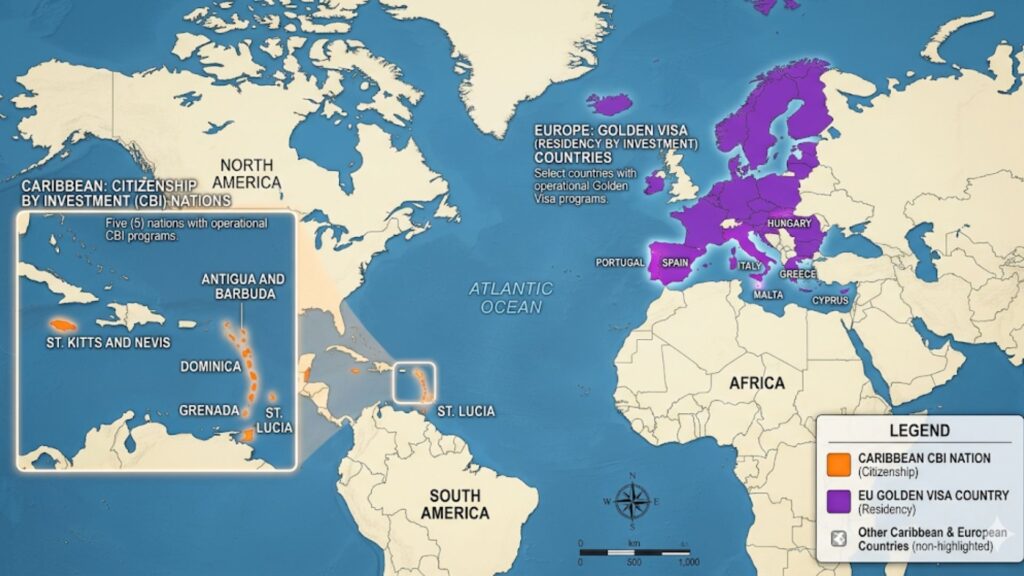
Five Caribbean nations operate active CBI programs in 2026: Antigua and Barbuda, Dominica, Grenada, St. Kitts and Nevis, and St. Lucia. Each requires due diligence, a clean record, and proof of legitimate source of funds.
EU Golden Visa: A residence permit, with citizenship as a future option
An EU Golden Visa is a residence permit obtained through a qualifying investment in an EU member state. You do not become a citizen at the point of investment. You become a legal resident with the right to live in that country and travel freely within the Schengen Area. Citizenship is available later, but only if you meet the country’s full naturalization requirements: residence duration, language proficiency, integration, and in some cases tax residency.
Portugal and Greece are the two most active EU Golden Visa programs in 2026. Spain closed its real estate route in 2025. Cyprus and Malta have ended their direct citizenship-by-investment programs entirely. Italy, Latvia, and a few smaller programs continue at lower volumes.
The headline difference: a Caribbean citizenship arrives in months. An EU Golden Visa is the start of a five-to-ten-year journey, with the passport at the end if you stay the course.
The Numbers in 2026
Updated minimums, processing times, and physical presence requirements as currently in force.
Caribbean CBI minimums
All five programs raised their floors to a minimum $200,000 contribution in July 2024 under a regional Memorandum of Agreement. The current donation-route minimums for a single applicant are:
- Dominica: $200,000 (state fund) or $200,000 (real estate)
- St. Lucia: $240,000 (National Economic Fund) or $300,000 (real estate or government bonds)
- Antigua and Barbuda: $230,000 (NDF) for a family of up to four, or $260,000 (real estate)
- Grenada: $235,000 (National Transformation Fund) or $270,000 (real estate)
- St. Kitts and Nevis: $250,000 (Sustainable Island State Contribution) or $325,000 (real estate)
Processing times range from four to six months for most programs. St. Kitts offers an Accelerated Application Process in roughly sixty days for an additional fee. None of the five Caribbean programs require physical relocation, although a 30-day physical presence requirement within the first five years was agreed regionally and is being implemented under the Eastern Caribbean Citizenship by Investment Regulatory Authority framework expected to take full effect in 2026.
EU Golden Visa minimums
Portugal removed the real estate route in October 2023. Spain ended its real estate route in April 2025. Greece restructured into a three-zone system in August 2024. The current state of the two main remaining programs:
Portugal Golden Visa
- Investment fund route: €500,000 minimum in a CMVM-regulated fund (cannot be invested in real estate)
- Cultural donation route: €200,000 to approved cultural heritage projects in low-density areas, or €250,000 for general cultural support
- Research investment: €500,000
- Physical presence: an average of 7 days per year
- Path to citizenship: 5 years of legal residence (the clock starts at application submission, not approval)
- Current AIMA processing backlog: typically 12 to 18 months for the initial residence card, although time in processing counts toward the citizenship clock
Greece Golden Visa
- Zone A (Athens, Thessaloniki, Mykonos, Santorini, and other premium areas): €800,000 minimum, single property of at least 120 square meters
- Zone B (rest of Greece outside Zone A): €400,000 minimum, single property of at least 120 square meters
- Zone C: €250,000 for commercial-to-residential conversions or restoration of listed historical buildings, no size restriction, available anywhere in Greece
- Physical presence: no minimum stay to maintain the residence permit
- Path to citizenship: 7 years of tax residency, plus Greek language requirement
Greece is the cheapest entry into the Schengen Area at €250,000, but only through the Zone C heritage route, which requires more legal complexity and a specific type of property. Standard property purchases in most of the country now start at €400,000.
What Each One Actually Does for You
Investment minimums are easy to compare. The benefits diverge sharply, and that is where most buyers make the wrong choice.
Caribbean: Speed, mobility, no relocation
A Caribbean passport from St. Kitts and Nevis or Grenada gives visa-free or visa-on-arrival access to roughly 150 to 156 destinations, including the Schengen Area, the United Kingdom, Singapore, and Hong Kong. Grenada is unique among the five for its visa-waiver agreement with China and its E-2 Investor Visa Treaty with the United States, which lets Grenada citizens apply for non-immigrant business visas to live and operate companies in the US.
Caribbean CBI nations do not tax worldwide income, capital gains, or inheritance. The citizenship is inheritable. A practical example: a Lebanese entrepreneur whose primary banking problem is being unable to open accounts in Switzerland, Singapore, or the UAE can solve that problem in five months with a $250,000 St. Kitts contribution. He never has to move. He keeps his existing tax residency. His kids inherit the citizenship.
This is the Caribbean’s structural advantage: it solves banking, mobility, and family optionality fast, with no relocation, no language exam, no integration test.
EU Golden Visa: A real path to EU citizenship and tax planning
A Golden Visa from Portugal or Greece does not give you EU citizenship at the point of investment. It gives you the right to live, work, and study in that country, plus visa-free travel within the Schengen Area. After five years (Portugal) or seven years (Greece), if you meet the country’s naturalization requirements, you can apply for citizenship and a passport that ranks among the strongest in the world.
A Portuguese passport gives visa-free access to roughly 190 destinations, including the United States under the Visa Waiver Program. A Greek passport offers similar mobility plus full EU citizenship rights: live, work, and study anywhere in the EU permanently.
There is also a tax dimension that the Caribbean cannot offer. Portugal’s Non-Habitual Resident regime (in its current form for new applicants, the Tax Incentive for Scientific Research and Innovation) and Greece’s Non-Dom flat-tax regime allow qualifying foreign tax residents to legally optimize their global tax exposure. For an entrepreneur willing to spend meaningful time in either country, the lifetime tax savings can substantially exceed the original Golden Visa investment.
Practical example: an Indian software founder who plans to exit his company in five years and wants to spend a few years in Europe before that exit, with his family naturalized as EU citizens by the time his kids reach university age, fits the Portugal Golden Visa profile precisely. The Caribbean would not solve his EU university access problem.
The Regulatory Pressure Nobody Advertises
Both routes are under more political pressure in 2026 than at any point in the last decade. Any agency that does not tell you this before you sign is not protecting your interests.
EU pressure on Caribbean visa-free access
In December 2025, the European Commission published its 8th Annual Report under the Visa Suspension Mechanism. The report stated explicitly that the operation of citizenship by investment programs by visa-free third countries “in itself” constitutes grounds for suspending visa-free travel to the Schengen Area. This is a hardening of the EU’s position from earlier years, when the focus was on improving due diligence rather than discontinuing the programs.
The European Parliament’s LIBE Committee voted 41-10 to advance amendments to EU Regulation 2018/1806 that would target visa-free access for CBI countries. The revised Visa Suspension Mechanism entered into force at the end of December 2025. Vanuatu’s CBI passport already lost full Schengen access in November 2024 as a precedent.
In response, the five Eastern Caribbean nations are launching the Eastern Caribbean Citizenship by Investment Regulatory Authority (ECCIRA) in 2026 to harmonize standards, due diligence, and oversight. Whether this is sufficient to prevent partial or full Schengen visa-free suspension for one or more Caribbean CBI nations during 2026 to 2027 is genuinely uncertain. The European Travel Information and Authorization System (ETIAS) is also expected to become mandatory in late 2026, adding pre-travel screening for Caribbean passport holders entering Europe.
None of this makes Caribbean citizenship worthless. Even in a worst-case Schengen suspension scenario, holders retain the citizenship for life, retain visa-free access to roughly 130 to 140 other destinations including the UK, Singapore, and Hong Kong, and can still apply for short-stay Schengen visas. But anyone buying a Caribbean passport in 2026 specifically for European travel needs to understand this risk explicitly.
EU Golden Visa programs are not safe either
Cyprus closed its CBI program in 2020 after EU pressure. Malta’s CBI program was effectively struck down in April 2025 when the European Court of Justice ruled that it breached EU law by enabling naturalization through a transactional process. Bulgaria closed its CBI program in 2022. Spain ended its Golden Visa real estate route in 2025. Portugal removed real estate from its qualifying routes in October 2023.
The EU is making a coordinated push against any program where a member state effectively sells residence or citizenship rights with weak local connection. Greece and Portugal are the two largest active EU programs in 2026, and both have already been restructured under EU pressure. Further restrictions, deadline pressure, or redesign are realistic possibilities through 2026 and 2027.
Practical implication: a buyer who has decided on Greece or Portugal should not assume current rules and prices will hold for another two or three years. Programs that are still open today can shift their thresholds, asset classes, or processing timelines on relatively short notice.

Which One Fits Which Buyer
After several thousand applications across both routes, certain patterns repeat. The buyer profile usually answers the question more cleanly than any feature comparison table.
Caribbean CBI fits you if:
- You need banking access in jurisdictions your current passport cannot reach (CIS, MENA, certain Asian holders)
- You need a passport in months, not years, often for genuine business or family urgency
- You have no intention of relocating from your current home
- Your tax residency is already optimized and you do not need an EU tax incentive
- Your primary concern is mobility, not eventual EU citizenship for your children
- You can absorb the regulatory uncertainty around Schengen access through 2026 to 2027
EU Golden Visa fits you if:
- You are willing to commit five to seven years of structured presence and compliance
- Your endgame is full EU citizenship for yourself and your children, not just a second passport
- You want access to EU education and healthcare systems for your family
- You can use Portugal’s research-focused tax regime or Greece’s Non-Dom regime as part of a broader tax plan
- Your investable capital allows €500,000 to €800,000 deployment without straining your portfolio
- You are comfortable that the relationship between you and the country will deepen over time, not stay transactional
A note on combining both
The most sophisticated HNWI families increasingly do not choose. They build a structured portfolio: a Caribbean citizenship for immediate banking and mobility, plus an EU Golden Visa for the long-term citizenship and tax position, plus often a UAE Golden Visa for the residence and zero-tax base. Done correctly, this is not duplication. It is a layered system where each instrument solves a different problem.
This is more expensive in absolute terms, typically $750,000 to $1.5 million across all programs, but for families above a certain net worth, the resilience justifies the cost. Soland has structured this kind of multi-program package for clients whose primary goal is generational, not transactional.
The Common Mistakes Buyers Make
These show up repeatedly in pre-qualification calls, after the buyer has already started or even paid for the wrong program.
Buying Caribbean for European travel only
If your primary goal is unrestricted European access, buying a Caribbean CBI in 2026 is the wrong instrument. The Schengen visa-free access is exactly what is under EU pressure right now. A buyer in this situation usually fits a Greece or Portugal Golden Visa profile better, even at higher cost, because the EU residence card is itself the access mechanism.
Buying a Golden Visa expecting fast citizenship
Some buyers assume “Golden Visa” means the same thing across countries. It does not. Portugal’s five-year clock is one of the fastest in the EU, but it still requires basic Portuguese language proficiency at A2 level, a clean record over the entire period, and current AIMA processing delays of 12 to 18 months on the initial card. Buyers expecting a passport in two or three years are pricing in disappointment.
Treating government fees as the total cost
The advertised $200,000 or €500,000 minimum is the government investment, not the total cost. Across either route, expect an additional $40,000 to $100,000 in due diligence fees, government processing fees, agent fees, legal counsel, translations, apostilles, and family member surcharges. Any agency quoting a number that suspiciously matches the bare government minimum is either inexperienced or about to surprise you with itemized add-ons later.

A Quick Decision Framework
If you want one paragraph that captures the choice, here it is.
Choose Caribbean CBI when the problem you are solving is primarily about your current life: banking, business mobility, urgent travel, family optionality, and you do not want to relocate. Be aware of the Schengen risk through 2026 to 2027 and price your decision accordingly.
Choose an EU Golden Visa when the problem you are solving is primarily about your future life: building EU citizenship for your family, optimizing taxes through long-term residence, accessing European education for your children, and you can commit to five to seven years of structured presence.
Choose both if you have the capital and the goal is generational resilience rather than a single specific outcome.
Frequently Asked Questions
Can I get an EU passport directly through investment in 2026?
No. Cyprus closed its CBI program in 2020. Malta’s program was effectively closed by the European Court of Justice ruling in April 2025. There is currently no direct citizenship by investment route into the European Union. Every EU residency by investment program requires you to first obtain residence and then naturalize after meeting the country’s full requirements, which always include time, integration, and language.
Which Caribbean program has the strongest passport?
St. Kitts and Nevis has historically held the highest-ranked Caribbean passport, with visa-free or visa-on-arrival access to roughly 156 destinations. Grenada is the only Caribbean program with both a visa-waiver agreement with China and an E-2 Investor Visa Treaty with the United States, which makes it the preferred Caribbean choice for buyers who do business with both. Mobility rankings shift slightly each year, so the right answer depends on which countries actually matter to your travel and business patterns.
Will Caribbean passports lose visa-free access to Europe?
Genuine uncertainty. The European Commission’s December 2025 report and the European Parliament’s LIBE Committee vote in March 2025 have made suspension a real legal possibility. Vanuatu’s CBI passport already lost full Schengen access in November 2024. Whether one, several, or all of the five Eastern Caribbean nations face suspension during 2026 to 2027 depends on how the new ECCIRA framework is implemented and how Brussels evaluates compliance. Anyone buying a Caribbean passport primarily for Schengen access should treat this risk as material and seek written advisory acknowledgment from their agent.
Is the Portugal Golden Visa fund route safe if real estate is excluded?
The fund route requires investment in a CMVM-regulated fund where at least 60% of capital is allocated to Portuguese companies, and funds cannot invest in real estate. The structure is regulated, but returns vary widely (estimated 2% to 20% across the universe of qualifying funds), and capital is locked for a minimum five years. “Safe” means regulated and audited, not return-guaranteed. Selecting a fund without independent legal and financial due diligence on the fund manager, depositary bank, and underlying portfolio is one of the most common avoidable mistakes.
How long does each program actually take?
Caribbean CBI: typically four to six months from filing to passport, with St. Kitts and Nevis offering accelerated processing in roughly sixty days for an additional fee. Portugal Golden Visa: 12 to 18 months for the initial AIMA residence card under current backlog conditions, with the full path to citizenship at approximately five years from application submission. Greece Golden Visa: typically six to ten months for the residence permit, with the path to citizenship at seven years of tax residency. Add three to four weeks of preparation time before any of these clocks starts.
Which option is better for tax planning?
Different tools for different problems. Caribbean CBI nations do not tax worldwide income, capital gains, or inheritance, which makes them attractive for buyers who plan to take up Caribbean tax residency. But citizenship alone does not change your tax residency; you have to physically establish it. EU Golden Visas, paired with regimes like Portugal’s research-focused tax incentive or Greece’s Non-Dom flat-tax structure, can offer substantial tax planning advantages for buyers who do plan to spend significant time in Europe. Tax planning should always be coordinated with a cross-border tax advisor before any program is selected, not after.
Can I include my family?
Yes, in both routes, although the definition of “family” varies by program. Caribbean CBI programs typically include the spouse, dependent children up to a defined age, dependent parents, and in some programs grandparents and siblings. Antigua and Barbuda is the most family-inclusive Caribbean program. Portugal’s Golden Visa includes the spouse, dependent children, and dependent parents. Greece includes the spouse and dependent children up to age 21. Adding family members increases government fees and due diligence costs, often by 30% to 60% over the single-applicant cost.
The Honest Conclusion
The right answer depends on your specific situation, your timeline, your capital, and your appetite for regulatory uncertainty in 2026. There is no single best program. There is the program that fits the problem you are actually trying to solve.
If you are still uncertain after reading this, that is the correct response. The mismatch between buyer and program is the single largest source of wasted six-figure investments in this industry, and the agencies most willing to push you toward a fast “yes” are usually the ones earning the highest commission on the program you do not need.
Soland’s approach is the opposite. We pre-qualify before we sell. A structured advisory engagement evaluates your goals, your tax position, your family structure, and your timeline against the full universe of programs, including the option of recommending no program if the fit is not there. The output is a written program-fit ranking with the trade-offs explained, not a pitch deck.

Your next step
If you want this comparison applied to your specific situation, with your goals, your jurisdictions, and your capital, book a 30-minute Pre-Qualification call with the Soland advisory team. We will tell you which program (or which combination) actually fits before any government file is opened, and we will tell you in writing if none of them do.
Soland does not sell passports. We help families build the right cross-border structure for the next twenty years. Get in touch through solandworld.com or contact our advisory team directly.

