

St. Lucia’s citizenship by investment program is the quietest of the Caribbean five. It rarely leads headlines. It is not the cheapest (Dominica holds that at USD 200,000). It is not the fastest (St. Kitts’ 60-day route wins that). It does not have the specific US-China business hook that Grenada delivers, or Antigua’s family-size cost leadership. Its passport at approximately 139 visa-free destinations is at the low end of the Caribbean pack. And its standard processing at up to 18 months is the longest of the five. On most conventional rankings, St. Lucia looks middle-of-the-pack across every dimension.
But this framing misses what actually makes St. Lucia distinctive: it has the widest range of investment routes of any Caribbean CBI, including two structurally unique options that no other Caribbean program offers. St. Lucia’s government bond route (USD 300,000 in non-interest-bearing government bonds, held for 5 years) preserves capital in a way pure donations cannot. St. Lucia’s enterprise investment route (USD 3.5M+ creating three jobs) provides a genuine business investment pathway for HNWI who want productive deployment of capital rather than sunk-cost donations. For buyers who prioritize capital preservation or productive investment over the lowest headline cost, St. Lucia is often the structurally optimal Caribbean choice.
Here is how St. Lucia citizenship by investment works in 2026: the four investment routes, the specific advantages that make it the underrated choice, the honest limitations, and who St. Lucia actually fits.
2026 UPDATE: Under ECCIRA (Eastern Caribbean Citizenship by Investment Regulatory Authority, operational Q2 2026), St. Lucia CBI operates under the same harmonized framework as the other four Caribbean programs: USD 200,000 minimum floor (St. Lucia sits at USD 240,000), harmonized due diligence protocols, mandatory interview for applicants aged 16 and older, biometric capture, and 30-day physical residency across the first 5 years for files lodged from July 2026 onward. Applications filed before July 2026 lock in the pre-ECCIRA framework without the 30-day residency requirement. Source: ECCIRA framework Q2 2026.
What St. Lucia Citizenship Actually Is
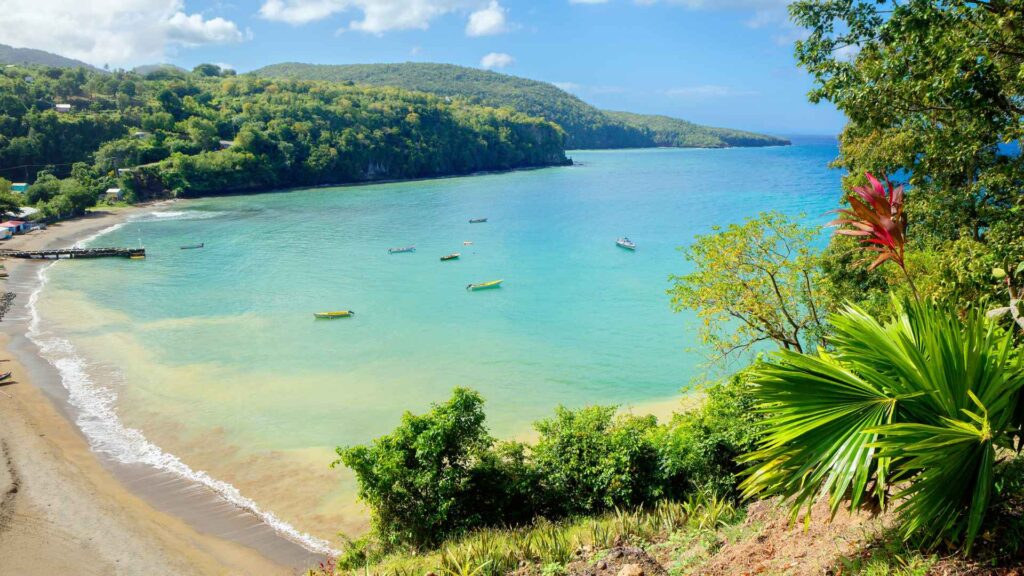
St. Lucia is a volcanic Eastern Caribbean nation of approximately 180,000 residents, known internationally for the twin Pitons (a UNESCO World Heritage site) and its dramatic mountain-and-sea landscape. Its CBI program launched in 2013, making it 13 years operational in 2026. The program is administered by the CIP St. Lucia (Citizenship by Investment Programme) under the direction of the Ministry of Finance.
Full citizenship with 4 investment routes
St. Lucia grants full citizenship for life through any of four qualifying investment routes. Unlike some Caribbean programs that offer only 2 or 3 routes, St. Lucia’s 4-route structure gives buyers more flexibility to match the investment vehicle to their specific priorities (cost minimization, capital preservation, real estate exposure, or productive business investment).
Citizenship is inheritable by descendants, permits dual nationality, and until July 2026 required no physical presence. Under ECCIRA (applications from July 2026), 30 days of physical residency in St. Lucia must be completed across the first 5 years of citizenship.
The Four Investment Routes in Detail
Route 1: National Economic Fund (NEF), USD 240,000 minimum
The NEF donation is St. Lucia’s baseline route and lowest headline cost:
- Single applicant: USD 240,000 donation
- Main applicant + spouse: USD 240,000
- Family of 4: USD 240,000 for main applicant + spouse + reduced cost for children
- Family of 5+: incremental dependents at reduced rates
Plus due diligence fees (USD 7,500 main applicant, USD 5,000 per additional adult), government fees, passport fees, and agent and legal fees. All-in cost for a single applicant via NEF is approximately USD 275,000 to USD 290,000. All-in cost for a family of 4 via NEF is approximately USD 285,000 to USD 305,000.
Route 2: Real Estate Investment, USD 300,000 minimum
The real estate route requires a minimum USD 300,000 investment in a government-approved real estate development, with a 5-year hold before resale. Approved developments are typically hotel or resort projects. The investor receives shares or ownership units in the approved property.
Government processing fees on the real estate route are USD 30,000 for the main applicant plus USD 15,000 per spouse and additional adult dependent. Due diligence and other fees apply. All-in cost for a family of 4 via real estate is approximately USD 375,000 to USD 400,000, higher than the NEF route but with potential capital recovery through eventual property resale.
Route 3: Government Bonds, USD 300,000 minimum (unique)
This is St. Lucia’s most distinctive route and one of two structurally unique features not offered by any other Caribbean CBI. The government bond route requires:
- Minimum USD 300,000 investment in St. Lucia government bonds
- Non-interest-bearing (the bonds do not pay coupons or interest during the hold period)
- 5-year mandatory hold period
- At the end of the 5-year period, the principal is returned (subject to specific program terms)
Additional government fees on the bond route apply. The trade-off is clear: unlike a pure donation, the USD 300,000 principal is eventually recoverable. Unlike a real estate investment, there is no exposure to property market fluctuations or specific project risks. But there is also no interest income during the 5-year hold; the opportunity cost of the capital is the return that USD 300,000 would have generated in alternative investments over 5 years.
For buyers who prioritize capital preservation over lowest headline cost, and who can absorb the opportunity cost of 5 years of non-interest-bearing capital, the bond route is structurally efficient. It converts what would otherwise be a USD 240,000 pure donation into a USD 300,000 non-interest loan that eventually returns the principal. Whether this is attractive depends on the buyer’s alternative investment opportunities and their opportunity cost calculations.
Route 4: Enterprise Investment, USD 3.5M+ minimum (unique)
The enterprise investment route requires a minimum USD 3.5 million investment in a qualifying St. Lucia enterprise that creates at least three permanent jobs (with a USD 6 million floor for enterprises creating at least six jobs). This route is used by very few applicants (annual figures typically in single digits) and is generally selected by buyers who have a genuine business interest in Caribbean regional operations, tourism development, or specific industry ventures.
Qualifying sectors have historically included tourism infrastructure, agriculture, information technology, and specialty manufacturing. The government reviews specific enterprise proposals for economic contribution and job creation potential before approval. This is not a purchase-a-passport structure; it is a genuine business investment that qualifies for citizenship as a consequence.

What Makes St. Lucia Distinctive
Beyond the four routes, St. Lucia has several specific features worth understanding.
Investment route diversity
Only St. Lucia offers all four route types (donation, real estate, bonds, enterprise) among the Caribbean five. Dominica offers donation + real estate. Antigua offers donation + real estate + business investment. Grenada offers donation + real estate. St. Kitts offers donation + real estate + public benefit. St. Lucia’s four-route structure is materially broader.
This matters most for buyers whose investment priorities differ from the norm. If capital preservation is your priority, St. Lucia’s bond route delivers it in a way no other Caribbean CBI does. If large-scale productive business investment matches your strategy, St. Lucia’s enterprise route provides a qualifying pathway. For buyers who fit the standard donation or real estate profile, St. Lucia is broadly competitive but not distinctive; for buyers with the specific capital preservation or business investment priorities, St. Lucia is uniquely suited.
Streamlined electronic application
St. Lucia has invested in digital application infrastructure that streamlines the process. Applications, document submission, and status tracking are handled through electronic systems, and the government’s licensed authorized agents typically use these systems to manage client applications. This can produce a smoother client experience compared to more paper-intensive processes at some other programs, even though St. Lucia’s overall processing timeline is longer.
The longer processing timeline
This is St. Lucia’s most significant limitation. Standard processing at up to 18 months is materially longer than the 6-9 months typical for Dominica, Antigua, and Grenada, or the 4-6 months for St. Kitts standard (or 60 days accelerated). For buyers with time-sensitive needs, St. Lucia is not the right choice. For buyers who can absorb the longer timeline, this may be a acceptable trade-off for the investment route flexibility.
Government processing capacity has been the limiting factor. While applications proceed methodically, the queue can extend the effective timeline significantly. Buyers who prioritize speed should evaluate St. Kitts (fastest) or Grenada (mid-range) rather than St. Lucia.
What the St. Lucia Passport Delivers
St. Lucia passport mobility is at the modest end of the Caribbean five, but the specific access it provides remains valuable.
Visa-free and visa-on-arrival access
St. Lucia passport provides visa-free or visa-on-arrival access to approximately 139 destinations, including:
- EU Schengen Area (subject to 2026-2027 EU regulatory review)
- United Kingdom (subject to review)
- Singapore, Hong Kong, and much of Southeast Asia
- Russia, and CIS states
- Most of the Caribbean and Latin America
- Not visa-free: US, Canada, Australia, New Zealand, Japan, China
The 139-destination figure is at the low end of Caribbean CBI passports (compared to St. Kitts at approximately 155-160, Antigua at 150, Grenada at 145, and Dominica at 140-160). For buyers whose Plan B priorities require the strongest possible passport mobility, St. Kitts is the structural choice. For buyers whose priorities are broader (tax planning, Plan B optionality, capital preservation, business investment), the passport mobility difference is meaningful but not decisive.
The EU Schengen risk applies equally
St. Lucia faces the same EU Schengen regulatory review as the other four Caribbean CBI programs. Any EU action on visa-free access would affect all five programs simultaneously under the ECCIRA harmonized framework. Buyers whose primary use case is European travel should factor this uncertainty into their decision across all Caribbean options.
Family Inclusion Under St. Lucia
St. Lucia family inclusion is broadly standard for Caribbean CBI:
- Spouse or registered civil partner
- Dependent children under 21 (higher than the 18-year threshold at some programs)
- Dependent children 21-30 who are full-time students and financially dependent
- Dependent parents over 55 who are financially dependent on the main applicant
- Newborns can be added after main applicant’s citizenship is granted, at reduced fees
- Future spouses of the main applicant can be added post-citizenship
The dependent-child threshold of 21 (rather than 18) is a modest structural advantage for families with children in the late-teen to young-adult range. Antigua remains the specific family champion for very large families through the UWI Fund, but St. Lucia’s dependent inclusion is broadly comparable to Dominica, Grenada, and St. Kitts for typical family sizes.
Who St. Lucia Fits
It fits you if:
- Capital preservation is your priority (the USD 300,000 non-interest-bearing bond route returns principal after 5 years)
- You have a genuine Caribbean business investment interest at USD 3.5M+ scale (enterprise route)
- You want investment route optionality across donation, real estate, bonds, and enterprise
- You can absorb the up-to-18-month processing timeline
- You value the streamlined electronic application experience
- You are comfortable with the 139-destination visa-free mobility (or have another passport for higher-mobility needs)
It does not fit you well if:
- You are a single applicant prioritizing lowest cost (Dominica at USD 200,000 is cheaper)
- You have a family of 4 prioritizing lowest cost (Antigua NDF at USD 230,000 is cheaper)
- You have a family of 6+ (Antigua UWI Fund at USD 260,000 with tuition benefits is materially better)
- You have time-sensitive processing needs (St. Kitts accelerated 60-day route is dramatically faster)
- You need US business access (Grenada E-2 Treaty is the only Caribbean option)
- You want the strongest possible Caribbean passport (St. Kitts leads on mobility)
Frequently Asked Questions
Why does St. Lucia take so long to process?
Standard processing time up to 18 months reflects government processing capacity constraints. St. Lucia’s CIP unit processes applications methodically, and the queue can extend the effective timeline compared to programs with larger administrative capacity or accelerated options. There is no publicly available accelerated route at St. Lucia comparable to St. Kitts’ 60-day option. Buyers with time-sensitive needs should evaluate faster alternatives.
Are the government bonds really non-interest-bearing?
Yes. The St. Lucia CBI government bond route provides for a USD 300,000 investment in non-interest-bearing government bonds held for a mandatory 5-year period, after which the principal is returned (subject to program terms). During the 5-year hold, no interest is paid. The opportunity cost of not earning yield on USD 300,000 for 5 years is a real economic cost that should be factored into route comparisons. At a conservative 4% annual yield in alternative investments, the opportunity cost is approximately USD 60,000 over the 5-year period; at a 6% yield, approximately USD 90,000.
Is the bond route better than the NEF donation?
Depends on the buyer’s opportunity cost of capital. NEF donation is USD 240,000 non-refundable. Bond route is USD 300,000 non-refundable during 5 years, returned as principal at year 5. If the buyer’s alternative use of that USD 60,000 differential (USD 300K bond minus USD 240K donation) would earn less than the return of principal at year 5 is worth, the bond route is preferable. If the differential capital could be deployed at high returns elsewhere, the donation route captures the difference. Specific analysis depends on the buyer’s opportunity cost.
What is the enterprise investment route actually used for?
Very few applicants use the enterprise route (typically single-digit annual applications). It is generally selected by HNWI who have genuine business interests in Caribbean regional development (tourism infrastructure, hospitality, agriculture, IT ventures) and see St. Lucia citizenship as a consequence of an investment they were already making. For buyers without a specific Caribbean business investment thesis, the enterprise route is not typically the structural choice.
How does the 139-destination passport compare in practice?
St. Lucia at 139 destinations is at the low end of Caribbean CBI passports. The difference from St. Kitts (approximately 155-160) is meaningful across specific destinations. However, the destinations most relevant to typical Caribbean CBI use cases (Schengen, UK, Singapore, Hong Kong, Russia) are covered by all Caribbean passports at broadly similar levels. The mobility difference matters most for buyers whose specific travel patterns include destinations where the Caribbean passports diverge.
Can I complete the residency requirement all at once?
Yes. Under ECCIRA (files from July 2026), 30 days of physical residency in St. Lucia can be completed in a single trip or split across multiple visits, so long as the total accumulates before the 5-year anniversary of citizenship. For buyers who prefer to bundle the requirement into a single extended visit (typically combined with tourism or business activities), this is fully permissible. There is no daily quota within the 5-year window.
Should I choose St. Lucia over St. Kitts if I want capital preservation?
St. Lucia’s bond route is the specific Caribbean CBI capital preservation instrument. St. Kitts’ SISC is a pure donation with no capital recovery. If capital preservation is your specific priority, St. Lucia’s bond route delivers it in a way St. Kitts does not. The trade-off is St. Lucia’s longer processing and weaker passport versus St. Kitts’ faster processing and stronger passport. For buyers who prioritize capital preservation over speed or passport mobility, St. Lucia is the structural choice.
The Honest Conclusion
St. Lucia is the Caribbean CBI’s least-discussed program, but the underrating misses its distinctive value proposition. The four investment routes (donation, real estate, non-interest-bearing bonds, enterprise) provide broader optionality than any other Caribbean CBI. The USD 300,000 bond route uniquely delivers capital preservation among Caribbean CBI options. The enterprise route provides a genuine large-scale business investment pathway. For buyers whose priorities align with these specific structural features, St. Lucia is often the optimal Caribbean choice.
The honest limitations are real: the up-to-18-month standard processing is the longest among Caribbean CBI, the 139-destination passport is at the low end of Caribbean mobility, and the program does not have the specific hooks (US E-2, family cost leadership, premium mobility) that make other Caribbean programs distinctive. For buyers with typical Caribbean CBI priorities (lowest cost, fastest speed, strongest passport, or US business access), other programs fit better. For buyers with the specific capital preservation or business investment priorities, St. Lucia is structurally optimized.
Your next step
Soland’s Pre-Qualification engagement evaluates whether St. Lucia’s specific route diversity aligns with your priorities, and compares it honestly against the other four Caribbean options. If capital preservation matters to you, we quantify the bond route’s economics against the NEF donation across your specific opportunity cost of capital. If speed or passport mobility matters more, we tell you to consider alternatives first.
If St. Lucia fits, we coordinate the application through licensed authorized agents under current rules. If a different program serves you better, we tell you that first. Soland does not sell passports. We help families build the right cross-border structure for the next twenty years. Get in touch through solandworld.com or contact our advisory team directly.

