
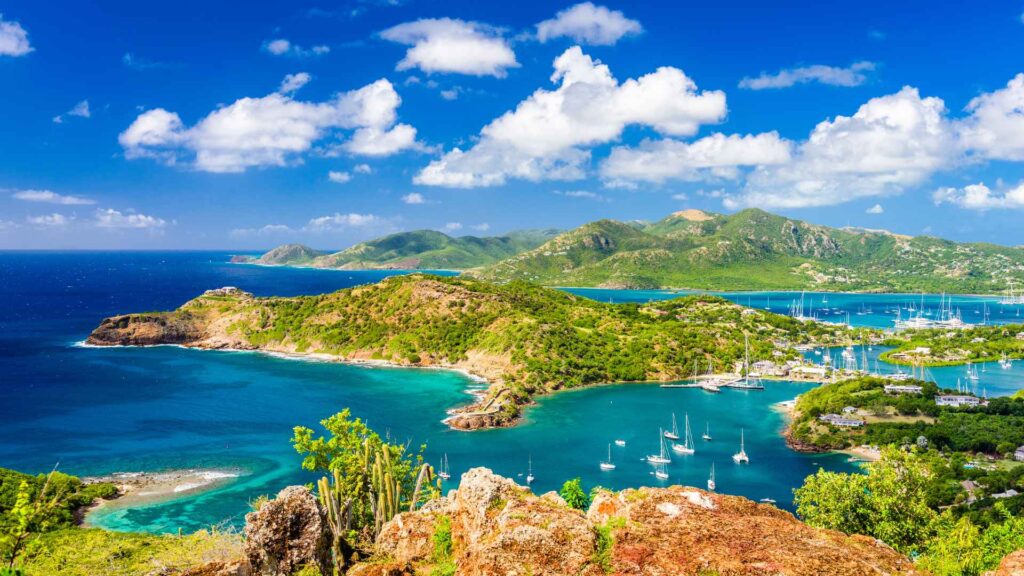
Antigua and Barbuda’s citizenship by investment program is not the cheapest Caribbean option for a single applicant (Dominica holds that position at USD 200,000). It is not the fastest (St. Kitts offers 60-day accelerated processing). It does not have the specific US-China business access that Grenada delivers. But for one specific buyer profile, Antigua is unbeatable: families with four or more members, particularly families with six or more members considering the University of the West Indies Fund route.
For a family of four, Antigua’s National Development Fund (NDF) at USD 230,000 is the cheapest Caribbean CBI, ahead of Grenada’s USD 235,000, St. Lucia’s USD 240,000, St. Kitts’ USD 250,000, and Dominica’s USD 250,000 (for family of 4). For a family of six or more, Antigua’s UWI Fund at USD 260,000 is dramatically cheaper than incremental-dependent pricing at other programs, and uniquely includes one year of tuition-free education at the University of the West Indies. Combined with Antigua’s broad definition of dependents (including grown children, parents, and grandparents), the program is structurally optimized for family relocation and multigenerational planning.
Here is how Antigua and Barbuda citizenship by investment works in 2026: the four investment routes, the specific family advantages, the 5-day residency requirement that predates ECCIRA, and who Antigua fits.
2026 UPDATE: Antigua and Barbuda has always required 5 days of physical residency within the first 5 years of citizenship, a feature that predates the ECCIRA framework. Under ECCIRA (operational Q2 2026), all five Caribbean CBI programs now require 30 days of residency across the first 5 years for files lodged from July 2026. Antigua’s pre-ECCIRA 5-day requirement is superseded by the 30-day ECCIRA standard for new applications. Applications filed before July 2026 remain subject to the original 5-day rule. Source: Antigua and Barbuda Citizenship by Investment Unit, and ECCIRA framework Q2 2026.
What Antigua and Barbuda Citizenship Actually Is
Antigua and Barbuda is a twin-island nation in the Eastern Caribbean, independent since 1981. Its CBI program launched in 2013 and has been continuously operational since. The program is administered by the Antigua and Barbuda Citizenship by Investment Unit (CIU) and grants full citizenship through a qualifying investment or donation.
Full citizenship with a modest residency requirement
Antigua grants full citizenship for life, inheritable by descendants, permits dual nationality (applicants do not need to renounce original citizenship), and has one specific feature that distinguished it before ECCIRA: a 5-day physical residency requirement in Antigua within the first 5 years of citizenship. Under ECCIRA (operational Q2 2026), all five Caribbean CBI programs now share a 30-day residency requirement for files lodged from July 2026, which supersedes Antigua’s earlier 5-day rule for new applications.
For applications filed before July 2026, Antigua’s original 5-day rule remains in effect. This modest presence requirement was never a deterrent for buyers, and combined with Antigua’s tropical climate and quality lifestyle, most applicants comfortably fulfill the requirement.
The Four Investment Routes
Antigua offers four qualifying investment routes, giving buyers more optionality than most Caribbean programs.
Route 1: National Development Fund (NDF), USD 230,000 for family of 4
The NDF donation is the most popular route and Antigua’s cost leader for a family of four. Contribution structure:
- Family of up to 4: USD 230,000 donation
- Family of 5 to 6: additional USD 15,000 per member above 4
- Family of 7+: additional USD 25,000 per member above 6
Plus due diligence fees (USD 7,500 main applicant, USD 4,000 per adult dependent), government fees, passport fees, and agent and legal fees. All-in cost for a family of four via NDF is typically USD 258,000 to USD 275,000.
Route 2: University of the West Indies (UWI) Fund, USD 260,000 for family of 6+
The UWI Fund is Antigua’s most distinctive route and the reason Antigua is unbeatable for large families. Structure:
- Family of 6 or more: USD 260,000 donation to the UWI Fund
- Includes one year of tuition-free education at the University of the West Indies for one dependent (typically eligible for children who qualify for university admission)
- Applies to families of 6+; not available for smaller families
For a family of 6+, this is dramatically cheaper than the incremental-dependent pricing under NDF or under other Caribbean programs. For a family of 8 (main applicant, spouse, and 6 dependents), NDF cost would be approximately USD 260,000 to USD 280,000. UWI Fund at flat USD 260,000 with the tuition benefit is materially better. The tuition benefit itself is worth USD 15,000 to USD 30,000+ depending on the specific program the child enrolls in at UWI.
Route 3: Real Estate Investment, USD 300,000 minimum
The real estate route requires a minimum investment of USD 300,000 in a government-approved development, with a 5-year hold before resale. Approved developments are typically hotels or resort projects; the investor receives shares or ownership units. Additional fees apply on top of the property investment.
For buyers who prefer a capital-preserving structure over a pure donation, the real estate route provides an investment vehicle. The trade-off is the 5-year hold, the specific risks of the underlying property investment, and the higher all-in cost (typically USD 350,000+ including fees) compared to the NDF donation.
Route 4: Business Investment, USD 400,000 minimum
The business investment route requires a minimum USD 400,000 investment in a government-approved business or a USD 5 million joint investment (with at least USD 400,000 per investor participating in the joint structure). This route is used less commonly than NDF or UWI and is generally selected by buyers with specific business interests in Antigua or Caribbean regional operations.
Why Antigua is the Family Champion
Three specific structural features make Antigua uniquely positioned for families.
Feature 1: NDF pricing for family of 4
At USD 230,000 for a family of 4, Antigua’s NDF is the cheapest Caribbean CBI for this specific family size. Dominica at USD 250,000 for family of 4, Grenada at USD 235,000 for family of 4, St. Lucia at USD 240,000 for family of 4, and St. Kitts at USD 250,000 SISC for family of 4 are all more expensive. The cost advantage for family of 4 is USD 5,000 to USD 20,000, meaningful but not dramatic.
Feature 2: UWI Fund for family of 6+
This is where Antigua becomes dramatically better than alternatives. For a family of 6 to 10 members, the flat USD 260,000 UWI donation with tuition benefit is materially cheaper than any Caribbean alternative’s incremental-dependent pricing. For a family of 8, Antigua’s total cost is approximately USD 285,000 to USD 305,000; other programs would be USD 325,000+ for the same family size. Combined with the value of one year’s tuition at UWI (USD 15,000 to USD 30,000+), the effective saving for a large family choosing Antigua is USD 50,000 to USD 100,000.
Feature 3: Broad dependent inclusion
Antigua defines dependents more broadly than most Caribbean programs. Eligible dependents include:
- Spouse or registered civil partner
- Dependent children under 18
- Dependent children 18-30 who are full-time students at accredited institutions and financially dependent on the main applicant
- Dependent parents and grandparents over age 55
- Dependent siblings under 30 who are unmarried and financially dependent
- Newborns and future spouses can be added after citizenship is granted
This broad definition allows extended families and multigenerational households to be included under a single application, which is meaningfully more inclusive than most Caribbean programs. For families with grown children in university, elderly parents or grandparents, and dependent siblings, Antigua’s structure captures all of them in one application.
Who Antigua Fits
Antigua’s specific advantages point to specific buyer profiles.
It fits you if:
- You have a family of 4 and prioritize cost (USD 230,000 NDF is the cheapest Caribbean CBI for family of 4)
- You have a family of 6+ and want the dramatically better UWI Fund pricing (USD 260,000 flat plus tuition benefit)
- You have children approaching university age who would benefit from UWI tuition benefits
- You have extended family (elderly parents, grown children in university, siblings) that Antigua’s broad dependent definition captures
- You are comfortable with the 30-day residency requirement under ECCIRA (or the pre-ECCIRA 5-day rule if filing before July 2026)
- You value program stability: 13 years of continuous operation since 2013
It does not fit you well if:
- You are a single applicant, in which case Dominica at USD 200,000 is meaningfully cheaper
- You specifically need US business access via E-2 Treaty, in which case only Grenada delivers it
- You need the fastest possible processing, in which case St. Kitts’ 60-day accelerated route is materially faster
- You want the strongest possible passport mobility, in which case St. Kitts has the edge
- You want investment route diversity for capital preservation, in which case St. Lucia’s four routes (including bond option) offer more optionality
Frequently Asked Questions
Is Antigua really the cheapest for family of 4?
Yes, at USD 230,000 NDF donation for a family of up to 4. Grenada at USD 235,000, St. Lucia at USD 240,000, Dominica at USD 250,000 (family of 4 through EDF), and St. Kitts at USD 250,000 SISC are all more expensive. The gap is not dramatic but is meaningful across all-in cost when fees are included.
How does the UWI Fund tuition benefit actually work?
Under the UWI Fund route (USD 260,000 for family of 6+), one dependent from the family is eligible for one year of tuition-free education at the University of the West Indies. The specific program eligibility depends on UWI admission requirements and the dependent’s qualifications. UWI operates campuses in Barbados, Jamaica, Trinidad, and Antigua. The tuition benefit is a specific structural advantage available only through Antigua’s UWI Fund route, unique among the five Caribbean CBI programs.
What does the 30-day residency requirement actually mean?
Under ECCIRA (files lodged from July 2026), 30 days of physical residency in Antigua must be completed across the first 5 years of citizenship. This can be split across multiple visits or concentrated in a single trip. There is no daily quota within the 5-year window; the total must accumulate to 30 days. Given Antigua’s climate and lifestyle, most families comfortably fulfill this requirement through vacation visits.
Can I add my elderly parents to my application?
Yes, dependent parents and grandparents over age 55 who are financially dependent on the main applicant can be included. Antigua’s broad dependent definition is one of its structural advantages: extended families and multigenerational households are captured in single applications. The specific documentation requirements to demonstrate financial dependency vary by circumstance and should be discussed with a licensed authorized agent.
What is the all-in cost for a family of 6?
For a family of 6 via UWI Fund route: USD 260,000 donation + USD 7,500 due diligence (main applicant) + USD 4,000 per adult dependent + USD 3,000 government fees per applicant + passport fees + agent and legal fees. Total typically USD 300,000 to USD 320,000. Compare to family of 6 via NDF (USD 230,000 + USD 15,000 per dependent above 4 = USD 260,000 base donation, plus fees) which would be USD 300,000 to USD 315,000 all-in. The UWI Fund becomes meaningfully cheaper at family of 7+.
Is the Antigua program safe from EU pressure?
All Caribbean CBI programs face the EU Schengen regulatory review through 2026-2027. Antigua is not distinctively exposed or protected; it faces the same collective risk as the other four Caribbean programs. The ECCIRA framework was designed partly to demonstrate industry-wide institutional maturity in response to EU concerns, but any EU action on Schengen access would affect all five programs simultaneously.
Do I need to visit Antigua to complete the application?
For the application itself, no. The interview under ECCIRA can be conducted in person at approved centers or (increasingly) virtually. Biometric capture typically requires attendance at an approved center. For the actual 30-day residency requirement (files from July 2026) or 5-day requirement (pre-July 2026 files), physical presence in Antigua is required, but this can be completed across the first 5 years of citizenship rather than during the application phase.
The Antigua Passport in Practice
Antigua’s passport delivers competitive Caribbean mobility with specific access profiles that matter for typical HNWI use cases.
Visa-free destinations
The Antigua and Barbuda passport provides visa-free or visa-on-arrival access to approximately 150 destinations, positioning it mid-pack among Caribbean CBI passports (behind St. Kitts at 155-160, ahead of Grenada at 145, Dominica at 140-160, and St. Lucia at 139). Key access includes:
- EU Schengen Area (currently visa-free for 90 days in any 180-day period; subject to EU 2026-2027 regulatory review)
- United Kingdom (currently visa-free for short stays)
- Singapore, Hong Kong, and much of Southeast Asia
- Russia (90-day visa-free access)
- Caribbean and Latin America (broad regional access)
- Not visa-free: US, Canada, Australia, New Zealand, Japan, China
The tax framework for citizens
Antigua and Barbuda operates a favorable tax framework for both citizens and residents. The country does not impose personal income tax on individuals who are not tax resident in Antigua. There is no capital gains tax, no inheritance tax, and no wealth tax. Corporate income tax applies to Antigua-source income at competitive rates.
For Antigua CBI holders who do not become Antigua tax residents (which is the typical arrangement, given the modest residency requirement), Antigua citizenship provides tax neutrality: no additional Antigua tax obligation as a consequence of citizenship. Cross-border tax positioning continues to depend on the individual’s actual tax residency location, which for most CBI holders remains in their original jurisdiction or in a separately chosen zero-tax base like the UAE.
For citizens who do establish Antigua tax residency (typically by spending 183+ days per year in Antigua), the framework remains favorable but requires specific analysis of source rules and any applicable tax treaties. Most Antigua CBI applications do not involve establishing Antigua tax residency; the citizenship provides passport and mobility benefits without changing the individual’s tax residency picture.
Common Mistakes to Avoid
Several common mistakes affect Antigua CBI applications and should be avoided.
Mistake 1: Assuming Antigua CBI eliminates original tax obligations
Antigua citizenship, in isolation, does not change the applicant’s tax obligations in their original country. If the applicant continues to be tax resident in their home country (typically by continuing to live there), the home country’s tax rules continue to apply to worldwide income. Antigua CBI provides a second passport and Antigua tax neutrality; it does not automatically end original tax obligations. Buyers who want tax optimization need to combine CBI with actual tax residency changes, which typically involves relocation to a different jurisdiction.
Mistake 2: Underestimating the all-in cost
The headline USD 230,000 NDF donation is not the total cost. All-in for a family of 4 via NDF includes approximately USD 7,500 main applicant due diligence, USD 4,000 per adult dependent, USD 3,000 government fees per applicant, USD 500 passport fees per person, and USD 20,000-35,000 agent and legal fees. Total approximately USD 258,000 to USD 275,000. For UWI Fund route (family of 6+), all-in totals are approximately USD 290,000 to USD 315,000. Budgeting only for the headline donation figure is a common mistake.
Mistake 3: Ignoring the illegal financing enforcement
Since 2024, Caribbean governments (including Antigua) have intensified enforcement against unauthorized financing arrangements. Agent-provided payment plans, third-party loans specifically for CBI, and discounted government fees offered outside official rates have been prohibited. Applications found to involve prohibited financing schemes have been rejected. Any offer of financing on Antigua CBI that is not explicitly government-approved should be treated as a structural risk to the application.
Mistake 4: Applying based only on family cost without evaluating alternatives
For family of 4, Antigua at USD 230,000 NDF is USD 5,000 cheaper than Grenada at USD 235,000 NTF. But Grenada uniquely provides US E-2 Treaty access and China 30-day visa-waiver. If US business access is anywhere in the family’s future planning, the USD 5,000 saving through Antigua may be a poor trade for the loss of US access. Cost is one dimension; specific structural features (US access, education benefits, capital preservation) may matter more depending on the family’s priorities.

The Honest Conclusion
Antigua and Barbuda’s citizenship by investment program is the structural choice for families of four or more, particularly families of six or more considering the UWI Fund route. At USD 230,000 for family of 4 or USD 260,000 flat for family of 6+ with tuition benefits, Antigua’s family-size pricing is genuinely better than the other four Caribbean CBI programs. Combined with the broad dependent definition (extending to parents, grandparents, and dependent siblings under 30), Antigua is structurally optimized for multigenerational family relocation and comprehensive family inclusion.
For single applicants, Dominica remains cheaper. For US business access, Grenada remains the only Caribbean option. For the strongest passport or fastest processing, St. Kitts remains the choice. For investment route diversity, St. Lucia offers more options. But for families of the specific structure Antigua serves, no other Caribbean CBI matches the pricing or the inclusive family framework.
Your next step
Soland’s Pre-Qualification engagement evaluates whether Antigua’s specific family-focused advantages align with your household structure, and compares it directly against the other four Caribbean options and non-Caribbean alternatives. We compare programs honestly based on your actual family size and structure, not generic marketing profiles.
If Antigua is the right fit, we coordinate the application through licensed authorized agents under current rules. If a different program serves your family better, we tell you that first. Soland does not sell passports. We help families build the right cross-border structure for the next twenty years. Get in touch through solandworld.com or contact our advisory team directly.

